tea.doctor · sampling channel Encyclopedia · School · Atlas · Pu-erh · Equipment EN · RU · · · FR · ES · AR
tea.doctor Browse all →

home · topic

Pigment chemistry

Theabrownins — the dark molecules of aged tea

chá hè sù · 茶褐素

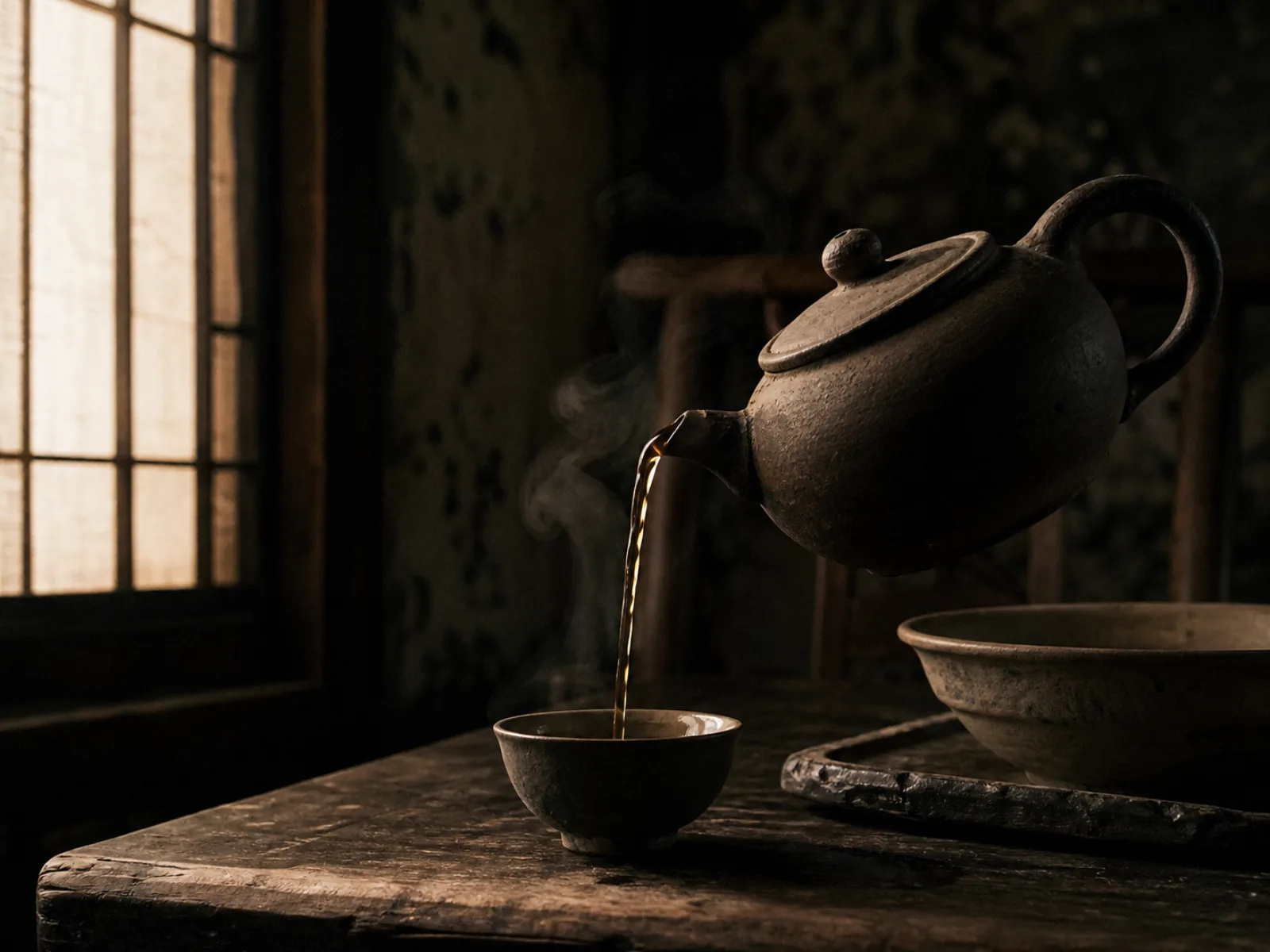
Theabrownins are the heavy, water-soluble pigments that accumulate when tea polyphenols oxidise and ferment over time — the chemistry behind shu pu'er's mahogany cup and aged sheng's slow shift from amber to garnet. They are also the molecule a 2019 Kunming Medical University paper put squarely on the desks of lipid researchers, with claims that deserve a careful read.

Theabrownins — the <em>dark molecules</em> of aged tea

From wet-pile fermentation to peer review

Theabrownins (chá hè sù, 茶褐素) sit at the end of a long oxidation chain. When fresh green tea is brewed, the dominant pigments are catechins — colourless in solution, astringent on the palate. Bruise the leaf, give it oxygen and microbial company, and those catechins polymerise: first into theaflavins (the bright orange of a good hóng chá), then into thearubigins (the deeper red of a mature black tea), and finally into theabrownins — high-molecular-weight, brown, and only marginally astringent. They are why a fifteen-year-old sheng cake from a Yiwu garden no longer tastes the way it did in 2010, and why a properly fermented shu cake from Menghai Tea Factory pours almost black from the gaiwan.

The modern interest in this pigment class is inseparable from the invention of wò duī (渥堆), the wet-pile fermentation process formalised at Kunming Tea Factory in 1973 and refined at Menghai through the late 1970s. Wò duī compresses decades of natural ageing into roughly forty-five days of controlled microbial activity — Aspergillus niger, Blastobotrys adeninivorans, and a shifting cast of yeasts work through the leaf pile at 55–65 °C. Theabrownin content in finished shu pu’er routinely measures 8–12% of dry weight, against under 2% in a fresh sheng. Aged sheng eventually catches up, but slowly: a 1998 Menghai sheng we tasted last year still showed lower theabrownin levels than a five-year-old shu from the same factory.

This is where the 2019 paper enters. A Kunming Medical University group, publishing in Nature Communications, reported that purified theabrownins from Pu’er tea lowered serum cholesterol in mice by altering bile acid metabolism through the gut microbiome. The mechanism was specific, the dose was high, and the species was murine — three caveats that mainstream coverage promptly dropped. Our companion piece, Aged sheng and serum lipids — a measured look at the 2019 paper, walks through the methodology slowly: what the controls were, what the effect size meant, and why a 300 mg/kg purified extract is not the same thing as a daily gaiwan of shú pǔ’ěr.

The microbiome angle deserves its own treatment, which we give it in Shu pu’er and the gut microbiome — small studies, big claims. The honest summary: human trials exist, most are small (n under 60), most are short (under twelve weeks), and the effect sizes for lipid markers cluster around modest. None of this makes theabrownins uninteresting. It makes them a research subject, not a prescription.

For drinkers, the practical question is whether the pigment chemistry that produces these molecules also produces a tea worth steeping. We think it does — but the case is made on the cup, not the chromatogram. The cross-archive on puerh.app covers the wò duī process and ageing taxonomy in production detail, and tea.school has a tasting module that walks through the visual and aromatic markers of theabrownin development. This page is the medical-adjacent companion: what the molecule is, what is claimed for it, and what the evidence will and will not support.

Nothing on tea.doctor is medical advice. Tea is a beverage with a long history and a growing research literature — both deserve patience.

18 articles

In this topic

  1. — 01

    شاي السينج المعتق ودهون المصل — نظرة متفحصة على ورقة 2019

    أفاد فريق جامعة كونمينغ الطبية بأن الثيابراونينات المستخلصة من شاي البو-إره خفضت الكوليسترول لدى الفئران. انتشرت الورقة بعيدًا — أحيانًا أبعد مما ينبغي. إليك ما قاسته، وما لم تقسه، وكيف يتناسب السنج المعتق مع الصورة.

  2. — 02

    شو بو إير والميكروبيوم المعوي — دراسات صغيرة، ادعاءات كبيرة

    أطلقت ورقة بحثية صدرت عام 2019 من كونمينغ حول الثيابرونين موجة صغيرة من الحماس للميكروبيوم تجاه شو بو إير. الكيمياء حقيقية، بيانات الفئران مثيرة للاهتمام، الأدلة البشرية ضعيفة — إليك ما تقوله الأدبيات فعلياً.

  3. — 03

    Aged sheng and serum lipids — a measured look at the 2019 paper

    A Kunming Medical University team reported that theabrownins extracted from pu'er lowered cholesterol in mice. The paper travelled far — sometimes too far. Here is what it measured, what it did not, and how aged sheng fits into the picture.

  4. — 04

    Shu pu'er and the gut microbiome — small studies, big claims

    A 2019 Kunming paper on theabrownins ignited a small wave of microbiome enthusiasm for shu pu'er. The chemistry is real, the mouse data is interesting, the human evidence is thin — here is what the literature actually says.

  5. — 05

    Theabrownin isolation — what the Kunming labs have done since 2019

    Since a groundbreaking 2019 paper from Kunming Medical University, theabrownins — the dark, complex pigments that emerge during the microbial fermentation of shu pu'er and the slow oxidation of aged sheng — have moved from a curiosity of tea color to a focal point of bioprospecting. What has been isolated, what has not, and what a cup of well-aged tea may actually deliver.

  6. — 06

    Sheng añejo y lípidos séricos — una mirada medida al artículo de 2019

    Un equipo de la Universidad Médica de Kunming informó que las teobrowninas extraídas del pu'er redujeron el colesterol en ratones. El artículo viajó lejos — a veces demasiado lejos. Esto es lo que midió, lo que no midió y cómo el sheng añejo encaja en el panorama.

  7. — 07

    Shu pu'er y el microbioma intestinal — estudios pequeños, grandes afirmaciones

    Un artículo de Kunming de 2019 sobre las teabrowninas encendió una pequeña ola de entusiasmo por el microbioma para el shu pu'er. La química es real, los datos en ratones son interesantes, la evidencia en humanos es escasa — esto es lo que dice realmente la literatura.

  8. — 08

    Le sheng vieilli et les lipides sériques — un regard mesuré sur l’article de 2019

    Une équipe de la Kunming Medical University a rapporté que les théabrownines extraites du pu’er abaissaient le cholestérol chez la souris. L’article a voyagé loin — parfois trop loin. Voici ce qu’il a mesuré, ce qu’il n’a pas mesuré, et comment le sheng vieilli s’inscrit dans le tableau.

  9. — 09

    Le shu pu'er et le microbiote intestinal — petites études, grandes affirmations

    Un article de Kunming de 2019 sur les théabrownines a déclenché une petite vague d’enthousiasme pour le microbiote autour du shu pu'er. La chimie est réelle, les données sur les souris sont intéressantes, les preuves humaines sont minces — voici ce que dit réellement la littérature.

  10. — 10

    Выдержанный шэн и липиды сыворотки — взвешенный взгляд на статью 2019 года

    Команда Куньминского медицинского университета сообщила, что теабраунины, извлечённые из пуэра, снижали холестерин у мышей. Статья разошлась далеко — иногда слишком далеко. Здесь — что она измерила, чего не измерила и как выдержанный шэн вписывается в картину.

  11. — 11

    Шу пуэр и кишечный микробиом — небольшие исследования, громкие утверждения

    Статья 2019 года из Куньмина о теабраунинах вызвала небольшую волну интереса к микробиому для шу пуэра. Химия подлинная, данные на мышах интересные, доказательств на людях мало — вот что на самом деле говорит литература.

  12. — 12

    Выделение теаброунинов — что лаборатории Куньмина сделали с 2019 года

    После прорывной статьи 2019 года Куньминского медицинского университета теаброунины — темные, сложные пигменты, возникающие при микробной ферментации шу пуэра и медленном окислении выдержанного шэна — перешли из разряда любопытного окрашивания в фокус биопроспектинга. Что было выделено, что нет и что на самом деле может дать чашка хорошо выдержанного чая.

  13. — 13

    陈年生普与血脂——审慎解读 2019 年论文

    昆明医科大学团队指出,从普洱茶萃取的茶褐素能降低小鼠胆固醇。这篇论文传播得很远——有时过远了。本文梳理它测量了什么、没测量什么,以及陈年生普在图景中的位置。

  14. — 14

    Shu pu'er 与肠道微生物——小型研究,大胆宣称

    2019 年昆明一篇关于茶褐素的论文,点燃了对 shu pu'er 肠道微生物方面的一股小热潮。化学确实存在,小鼠数据令人感兴趣,人类证据薄弱——以下是文献实际所说的。

  15. — 15

    茶褐素的分离——昆明实验室自2019年以来的进展

    自2019年昆明医科大学一篇具有突破性的论文以来,茶褐素——这类在熟普洱茶微生物发酵和陈年生普洱缓慢氧化过程中形成的深色复杂色素——已从茶汤颜色的一项奇趣,转变为生物探勘的焦点。已被分离出什么,什么还没被分离,以及一杯陈化良好的茶可能真正带来的益处。

  16. — 16

    陳年生普與血脂——審慎解讀 2019 年論文

    昆明醫科大學團隊指出,從普洱茶萃取的茶褐素能降低小鼠膽固醇。這篇論文傳播得很遠——有時過遠了。本文梳理它測量了什麼、沒測量什麼,以及陳年生普在圖景中的位置。

  17. — 17

    Shu pu'er 與腸道微生物——小型研究,大膽宣稱

    2019 年昆明一篇關於茶褐素的論文,點燃了對 shu pu'er 腸道微生物方面的一股小熱潮。化學確實存在,小鼠數據令人感興趣,人類證據薄弱——以下是文獻實際所說的。

  18. — 18

    茶褐素的分離——昆明實驗室自2019年以來的進展

    自2019年昆明醫科大學一篇具有突破性的論文以來,茶褐素——這類在熟普洱茶微生物發酵和陳年生普洱緩慢氧化過程中形成的深色複雜色素——已從茶湯顏色的一項奇趣,轉變為生物探勘的焦點。已被分離出什麼,什麼還沒被分離,以及一杯陳化良好的茶可能真正帶來的益處。