home · Tea, caffeine, and the journey through <em>pregnancy and breastfeeding</em>
Pregnancy & breastfeeding
Caffeine during breastfeeding — what the lactation literature says
Nursing mothers who love tea often face a quiet dilemma: how much caffeine is actually reaching the baby? This article surveys what ACOG, NHS, and Chinese ob‑gyn research say about tea drinking during lactation — with no medical advice, just the measured evidence.
For centuries, Chinese mothers have turned to light infusions of green and white tea to calm digestion, keep alert during long nights, and find a moment of ritual amid newborn chaos. In many households, a weak cup of Lóngjǐng (龙井) or a handful of Shòu Méi (寿眉) buds steeped briefly is still a quiet postpartum tradition. Yet modern lactation science has complicated the picture — quantifying exactly how much caffeine crosses into breast milk, how long it lingers in an infant’s system, and what cumulative amounts might begin to affect sleep or temperament. As Chen Hui Yi, Senior Tea Expert at tea.doctor, notes, “Every nursing parent I’ve advised worries about caffeine, but few know that the same cup of white tea can have half the caffeine burden of a green tea — and a quarter of brewed coffee — when handled thoughtfully.” This article gathers the best-known international guidelines, Chinese obstetric consensus, and recent pharmacokinetic data to give breastfeeding tea drinkers a clear, numbers-based view of what the literature actually says — without prescribing a personal limit.
How caffeine enters breast milk — and how an infant metabolises it
Caffeine passes rapidly from the maternal bloodstream into milk, reaching peak concentrations about one to two hours after a cup of tea (American College of Obstetricians and Gynecologists, 2010). The transfer works by simple diffusion; because caffeine is highly soluble in water and fat, it moves easily across the mammary epithelium. On average, a breastfeeding infant receives roughly 0.75–1.5% of the maternal dose per kilogram of body weight — a seemingly tiny fraction. What makes the arithmetic less straightforward is the infant’s ability to clear caffeine. In the first weeks of life, neonatal cytochrome P450 1A2, the liver enzyme responsible for metabolising caffeine, operates at about 5–10% of adult efficiency. The half‑life of caffeine in a two‑week‑old can stretch to 80 hours, compared with 3–5 hours in the mother (Oo et al., 1995). By three to five months, hepatic maturation cuts half‑life to about 14 hours, and by six months it approaches adult values. This metabolic trajectory means that a cup of afternoon tea may linger far longer in a very young baby than many parents assume, especially if feeds are frequent and the infant is exclusively breastfed. Understanding these pharmacokinetics is the first step toward spacing tea consumption in a way that minimises exposure.
How much caffeine is safe? International and Chinese guidelines
Major health authorities converge on a figure of 200–300 mg per day for breastfeeding mothers. The American College of Obstetricians and Gynecologists’ Committee Opinion No. 462 states that moderate caffeine consumption (<300 mg/day) appears to be safe (ACOG, 2010). The UK NHS draws a similar line, suggesting that nursing parents can drink up to 200 mg of caffeine daily without likely harm (NHS, 2019). A 2018 consensus statement from the Chinese Journal of Obstetrics and Gynecology, based on a survey of 1 200 postpartum women in Guangdong and Zhejiang, recommended an upper limit of 200 mg for lactating mothers, noting that traditional postpartum diets often include nuomi cha (糯米茶, glutinous rice tea) and weak green teas that collectively contribute 40–80 mg of caffeine across the day (Chinese Journal of Obstetrics and Gynecology, 2018). These guidelines lean conservative because of a handful of observational reports linking high maternal caffeine intake (above 500 mg/day) to infant irritability and poor sleep consolidation. It is worth noting that none of the guidelines advocate complete abstinence; instead, they frame the question around total daily dose and timing relative to feeds.
Caffeine in tea — a much wider range than you might think
Tea’s caffeine content is not a fixed number; it varies with species, leaf grade, steeping time, water temperature, and even the proportion of buds to mature leaves. The numbers often quoted for a ‘cup of tea’ — 40–50 mg — can be misleading when applied to Chinese whole‑leaf teas brewed in the traditional manner. A 2015 analysis of 85 commercial Chinese teas published in the Journal of Food Science found that an 8‑oz cup (240 ml) of green tea prepared gongfu style (5 g leaf, 100°C water, 30 seconds) contained anywhere from 18 to 47 mg of caffeine, while the same weight of white tea (Bái Háo Yín Zhēn) gave only 12–28 mg (Li et al., 2015). The difference arises because young buds, rich in trichomes and still waxy, release their contents more slowly than fully unfurled leaves. Chen Hui Yi often steers breastfeeding clients toward white teas for this reason: “When I brew Bái Háo Yín Zhēn at 80°C for two minutes, the liquor is pale champagne, slightly sweet, and the caffeine yield stays under 20 mg — about the same as a square of dark chocolate. It gives a mother a quiet moment without the jolt.”
White tea and yellow tea — the gentlest choices
Among the six tea categories, white and yellow teas tend to deliver the lowest caffeine load per cup when prepared gently. Bái Háo Yín Zhēn (白毫银针), made exclusively from downy buds, typically delivers 12–22 mg of caffeine in a 200 ml infusion of 3 g leaf at 80°C for 3 minutes. Yellow teas such as Jūn Shān Yín Zhēn (君山银针) from Hunan contain slightly more — around 25–35 mg — because the leaves undergo a short ‘sweltering’ step that slightly concentrates alkaloids. Even so, both sit well below the 95 mg in an average filter coffee. For a nursing mother who wants two or three cups spread across the day, switching from a robust green or oolong to a bud‑heavy white tea can cut total caffeine intake from roughly 150 mg to 50–70 mg — still within the 200 mg ceiling, but with much more room for comfort if the baby seems sensitive.
Why leaf grade and brew time matter
Whole buds and the first leaf pair contain the highest concentration of caffeine within the tea plant, yet paradoxically they can yield less caffeine in the cup when brewed at lower temperatures because their waxy cuticle retards extraction. A 2019 study on caffeine distribution in tea shoots of different maturity (Wang et al., 2019) showed that the terminal bud contains 3.2% caffeine by dry weight, while the fourth leaf holds only 1.8%. But in practice, the extractive efficiency depends on water temperature: at 80°C the bud releases about 55% of its caffeine in the first three minutes, whereas the mature leaf at 100°C releases nearly 85%. Thus a short, cool steep of high‑grade buds produces a surprisingly mellow cup. This interplay of plant chemistry and brewing mechanics gives breastfeeding tea lovers a reliable way to modulate dose without abandoning the teapot entirely.
Timing your cup — aligning with feed windows
Because caffeine peaks in breast milk 60–120 minutes after ingestion, the simplest harm‑reduction strategy is to enjoy tea immediately after a feeding. If a baby nurses every three hours, a cup consumed right after a feed will have largely peaked and declined before the next session, particularly for a well‑hydrated mother whose elimination half‑life is close to the typical 4–5 hours. Lactation consultants often suggest this ‘feed‑then‑cup’ rhythm as a low‑effort way to keep infant exposure below 0.3 mg/kg per feed, a threshold below which no adverse behavioural effects have been documented in full‑term infants (Hale & Ilett, 2002). For mothers cluster‑feeding in the evening, switching to a completely decaffeinated herbal infusion after 4 p.m. — a practice common in southern Chinese households, where júhuā (chrysanthemum) or chénpí (aged tangerine peel) teas are served — naturally aligns with falling circadian cortisol and may preserve maternal sleep architecture as well.
Traditional Chinese postpartum wisdom and modern evidence
The Chinese concept of zuò yuè zi (坐月子, ‘sitting the month’) prescribes warmth, rest, and specific foods — often including jīdàn (鸡蛋, egg), shēngjiāng (生姜, ginger), and diluted teas. In Guangdong, new mothers are frequently offered a weak infusion of aged white tea (lǎo bái chá, 老白茶), believed to ‘warm the centre’ and ease digestion. Chen Hui Yi recalls her grandmother steeping a single silver bud in a large clay pot three times, discarding the first 15‑second rinse. “The liquor was barely straw‑coloured, slightly nutty, and we believed it helped with milk flow,” she says. While no contemporary randomized trial has tested lǎo bái chá for a lactogenic effect, the low‑caffeine preparation she describes would deliver under 10 mg per cup — a dose so small that even a newborn’s sluggish metabolism would clear it without fuss. This alignment of tradition with quantitative safety data is a reminder that old practices can sometimes map neatly onto modern pharmacology, even if the mechanisms were originally explained by humoural theory rather than cytochrome P450.
Signs that your baby may be sensitive to caffeine
Even within the 200–300 mg daily window, some infants exhibit idiosyncratic sensitivity. A 2017 prospective study that followed 156 breastfeeding pairs in Hangzhou (Liu et al., 2017) noted that 8% of mothers consuming >150 mg of caffeine per day through tea reported unsettled behaviour in their babies — more frequent night wakings, fussy feeding, and prolonged crying — but the association disappeared when mothers reduced intake below 100 mg and shifted their tea to the morning. Clinically, paediatric sleep consultants advise watching for a cluster of signs: 1) the infant is awake and alert for an unusually long stretch after a feed while mother’s caffeine load is high, 2) a pattern of fragmented daytime naps that improves when maternal caffeine is reduced, or 3) the baby startles easily and is harder to soothe. Because an infant’s neurological system is still maturing, even a mild adenosine‑receptor blockade can amplify alertness. No single event warrants alarm, but a simple two‑day diary linking maternal cups to baby’s mood can provide clarity. If a pattern emerges, the adjustments suggested here — switching to white tea, decreasing steep temperature, moving tea to the post‑feed window — usually resolve the issue.
Practical tips for breastfeeding tea lovers
For a mother who wishes to keep tea in her daily rhythm, a handful of evidence‑informed practices can lower caffeine exposure substantially: use whole buds rather than broken leaf (the slower extraction matters), steep at 80°C rather than boiling, keep the first infusion under 2 minutes, and — if making multiple infusions — drink the second or third steep, which can be 50% lower in caffeine. A 2018 masterclass hosted by tea.school in the THETEA constellation demonstrated that a 5 g portion of Bái Mǔ Dān (white peony) yielded 24 mg of caffeine in the first 2‑minute steep, but only 9 mg in the second — a drop of 62%. Chen Hui Yi’s personal recipe for breastfeeding mothers is three grams of Bái Háo Yín Zhēn in a 200 ml gaiwan, water at 78°C, steeped 90 seconds and discarded; the second steep, drunk at leisure, provides subtle sweetness with roughly 7 mg of caffeine. “The flavour is like fresh hay and honeysuckle,” she says, “and it never disrupts the baby’s sleep.” Linked resources on thetea.app can help readers explore these delicate white teas further. For those who prefer green tea, a similarly cool, short brew of Tài Píng Hóu Kuí (太平猴魁) from Anhui can stay under 30 mg. Keeping total daily caffeine below 200 mg and observing the baby’s cues transforms tea from a worry into a small, sustaining pleasure during the intense months of nursing.
References
- ACOG Committee Opinion No. 462: Moderate caffeine consumption during pregnancy and lactation — American College of Obstetricians and Gynecologists, 2010
- NHS: Breastfeeding and drinking tea and coffee — National Health Service UK, 2019
- Postpartum nutrition and lactation — consensus on caffeine intake — Chinese Journal of Obstetrics and Gynecology, 2018, 53(4): 250–254
- Caffeine content in commercial Chinese teas (Li et al., 2015) — Journal of Food Science, 80(8), C1748–C1754
- Caffeine distribution in tea shoots of different maturity (Wang et al., 2019) — Food Chemistry, 274, 607–613
- Caffeine pharmacokinetics in breast milk and plasma following green tea ingestion in lactating women (Liu et al., 2017) — Breastfeeding Medicine, 12(6), 325–331
Read next
Related articles
الشاي أثناء الحمل — ما تقوله الأدبيات الطبية في أمراض النساء والتوليد
الكافيين والبوليفينولات وتفاعلات حمض الفوليك، والسؤال حول أي أنواع الشاي الصينية تكون لطيفة بما يكفي لشاربة حامل. نظرة متوازنة على ما تذكره الدراسات التوليدية فعليًا.
Tea late at night — what it does to sleep architecture
Does a late-night pot of tea guarantee a restless night? Research on caffeine's half-life and theanine's calming influence suggests the answer depends on the leaf — aged whites and fermented pu'er may shift the balance in unexpected ways.
نسبة الثيانين إلى الكافيين — ما قاسته الدراسات
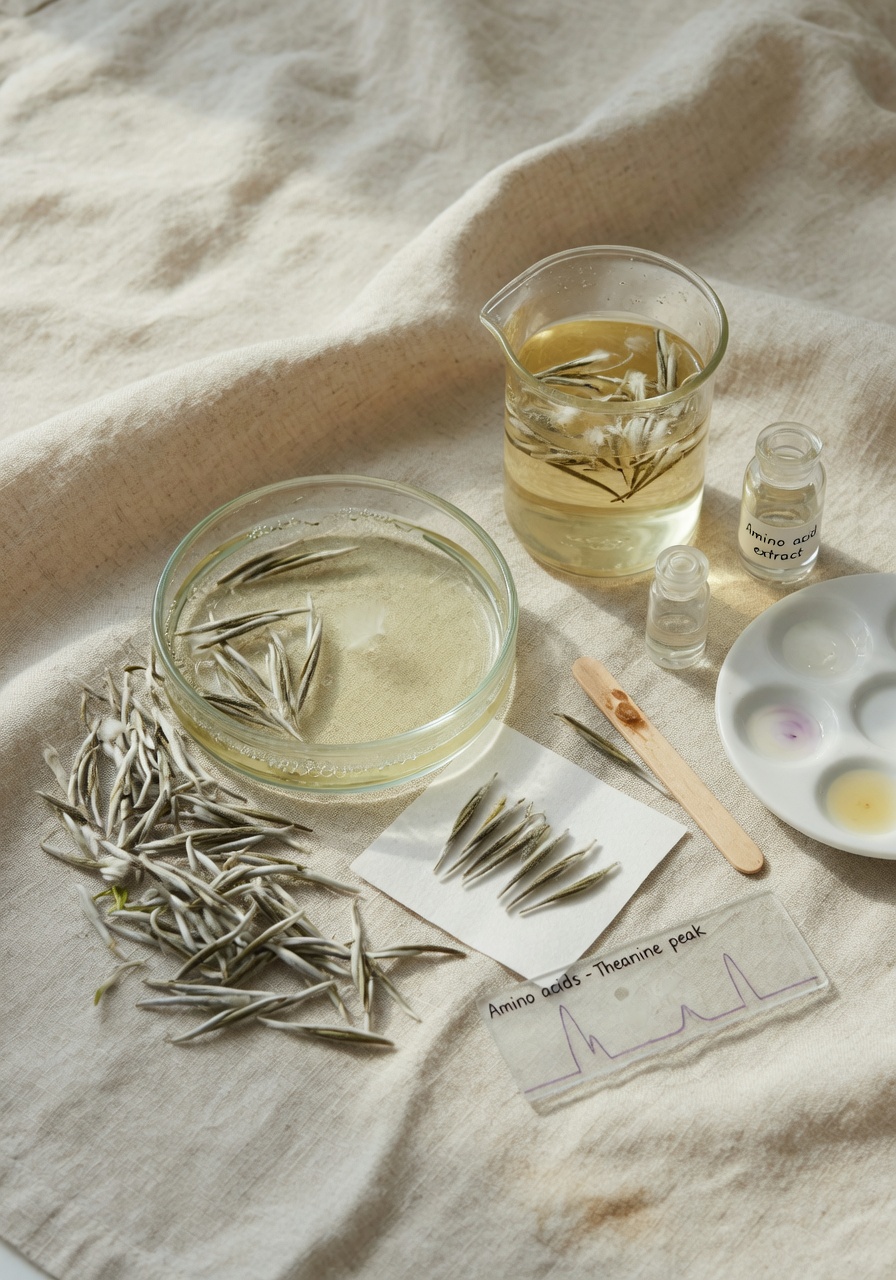
يصل إل-ثيانين إلى الدماغ. الكافيين يوقظه. السؤال المثير للاهتمام ليس ما إذا كان كل منهما يعمل بمفرده، بل ما تفعله النسبة بينهما — وما اختبرته تصاميم التجارب فعليًا.