home · What the science says about <em>tea’s effect on sleep architecture</em>
Tea and sleep
Tea late at night — what it does to sleep architecture
Does a late-night pot of tea guarantee a restless night? Research on caffeine's half-life and theanine's calming influence suggests the answer depends on the leaf — aged whites and fermented pu'er may shift the balance in unexpected ways.
Pouring tea after 9 p.m. splits tea drinkers into two camps: those who treat it as a sure path to a sleepless night and those who see a carefully chosen leaf as the warmest route to deep rest. The difference is not just personal tolerance; it lies in the chemical profile of the tea itself. Caffeine, the most familiar actor, suppresses slow-wave sleep and shortens total sleep time in a dose‑ and timing‑dependent manner. Yet tea also delivers l‑theanine, an amino acid that nudges the brain toward relaxed alpha‑wave states. The question is whether one can select a tea — a 2013 Shòu Méi cake, a well‑aged shēng pǔ’ěr, a decade‑old shú pǔ’ěr brick — whose theanine‑to‑caffeine ratio and sensory character tilt the scale toward calm rather than alertness. This article walks through the sleep‑architecture literature, the chemistry of ageing, and practical brewing choices that together shape the night.
The caffeine clock — half-life and sleep architecture
Caffeine peaks in plasma 30–60 minutes after ingestion and has a half‑life of 3–5 hours in healthy adults. That means a cup containing 40 mg of caffeine — typical of a white tea session made with 3 g of leaf — still leaves 20 mg circulating when the lights go out two hours later. The compound exerts its wake‑promoting effect by blocking adenosine receptors, delaying the onset of slow‑wave sleep (stage N3) and reducing total REM time. A 2017 meta‑analysis covering 2,711 participants confirmed that every 100 mg of caffeine consumed within four hours of bedtime cuts total sleep time by 11 minutes on average and adds 9 minutes to sleep latency. The effect is measurable even when the drinker feels subjectively unaffected — one reason that sleep‑architecture studies rely on polysomnography rather than morning questionnaires.
Theanine — the nighttime modulator
Where caffeine jolts, l‑theanine steadies. The amino acid crosses the blood–brain barrier and increases alpha‑band EEG activity, the pattern associated with wakeful relaxation. Unlike a sedative, theanine does not force sleep; instead it creates a calm, alert mental state that has been shown to shorten subjective sleep‑onset latency. In a 2019 randomised, placebo‑controlled trial, 200 mg of l‑theanine taken one hour before bed raised sleep efficiency and decreased the number of nocturnal awakenings in young adults. Tea leaves contain between 0.5 % and 2.5 % theanine by dry weight, and the amount that ends up in the cup depends on cultivar, picking season, and processing.
The theanine‑to‑caffeine ratio in different teas
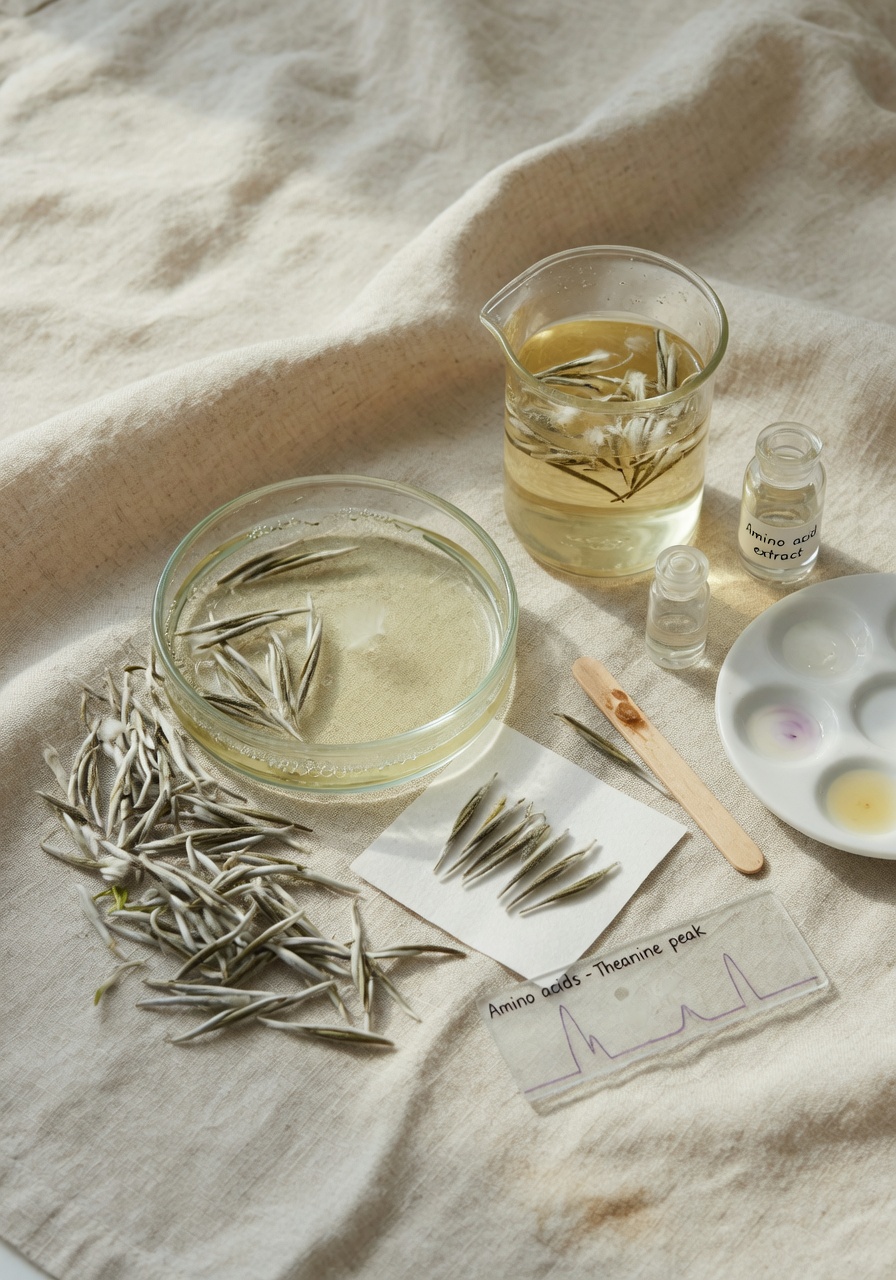
Fresh spring buds — the material for Bái Háo Yín Zhēn (白毫银针) — are rich in both caffeine and theanine, yielding a ratio around 1 : 1. Coarser leaves, such as those used for Shòu Méi (寿眉), contain less caffeine while retaining meaningful theanine, pushing the ratio toward 2 : 1 in favour of theanine. This is why one gram of Shòu Méi can feel softer than the same weight of silver‑needle buds. Pu‑erh adds a fermentation layer: although caffeine remains stable, the microbial activity of shú pǔ’ěr appears to generate secondary metabolites that interact with GABA pathways, though the evidence remains preliminary.
Timing and dosage
Small doses of theanine — 50–100 mg, equivalent to two to three grams of leaf — are enough to shift brain activity toward relaxation without sedation. Most studies use 200 mg, but tea drinkers rarely consume that much in a single sitting. The key is spacing: a 3‑g session of aged white tea enjoyed over 30 minutes releases theanine slowly, matching the gentle decline of caffeine’s peak. Chen Hui Yi, the tea.doctor’s senior white‑tea expert, notes that “a 2013 Shòu Méi I keep in my Guangdong storage yields a cup the colour of pale honey, with dried jujube and camphor notes — and if I finish it by 9:30 p.m., my sleep diary shows no extra awakenings.”
Aged white tea — the gentle nightcap
White tea’s minimal processing preserves both its theanine and a family of delicate aromatics that signal calm. Leaf‑grade white teas — Shòu Méi and Gōng Méi (贡眉) — offer lower caffeine than bud‑heavy grades, and when stored for seven to ten years in the dry‑humid oscillation of Fuding’s climate, they develop a rounded, woody‑sweet character that many drinkers associate with evening ease. Laboratory analyses by Li et al. (2020) showed a modest decline in caffeine content of white tea over the first five years of storage, falling from 3.1 % to 2.7 % in Shòu Méi, while theanine dropped only slightly, from 0.8 % to 0.7 % — preserving the favourable ratio.
Leaf grade matters: buds vs. leaves
The caffeine difference is not trivial. Bái Háo Yín Zhēn can contain 3.5–4.0 % caffeine, while a fourth‑grade Shòu Méi may test at 2.5 %. A 5‑g gongfu session of the former delivers roughly 175 mg of caffeine — comparable to a double espresso. Swapping to the latter brings that down to about 125 mg. When Chen Hui Yi wants something after dinner, she reaches for a 2016 Fuding Shòu Méi cake: “It’s like drawing a blanket over the senses — the liquor is amber‑toned, with stewed apricot and a hint of old bookshop, and the leaf never leaves me counting ceiling tiles.”
The role of aging
Time smooths both flavour and effect. Over a decade, polyphenol‑derived tannins polymerise, reducing astringency, while the tea’s fragrance shifts from fresh hay to dried date and camphor. The sensory experience alone may down‑regulate arousal through olfactory‑limbic pathways, a hypothesis that tea.school’s module on sensory neuroscience explores. The theanine‑to‑caffeine ratio, however, remains the measurable star — aged white tea holds it steady where younger green teas would lose it to rapid degradation.
Pu‑erh after sunset — shou vs. aged sheng
Pu‑erh drinkers often claim that shú pǔ’ěr, with its earthy‑sweet depth, is the ultimate evening companion. Fermentation transforms the leaf’s chemical landscape: catechins condense into theabrownins, and microorganisms produce GABA and other calming metabolites. While direct sleep studies on pu‑erh are scarce, a small observational study from Yunnan Agricultural University (2021) reported that daily shú pu‑erh drinkers had a 15 % shorter sleep‑onset latency than non‑drinkers, after adjusting for age and caffeine intake. Aged shēng pǔ’ěr offers a different path; its decades‑old leaf still carries caffeine but loses the grassy, astringent bite that can keep some people wired.
Shou pu‑erh — fermented comfort
A 2007 Dayi V93 shú brick, with its dense compression and molasses‑dark brew, is the sort of tea that invites slow drinking. The liquor feels coating, almost oily, with notes of black bread, camphor, and aged leather. Amgalan Chin, cross‑regional expert, observed that “shú pu‑erh doesn’t just taste quiet — when you brew it for a late session, the warmth stays in the belly, not in the racing mind.” Chemically, the high‑temperature wet‑pile process may generate pyrazines that exert a mild anxiolytic effect, though more research is needed.
Aged sheng — smooth but still alive
Twenty‑year‑old shēng pǔ’ěr from Menghai retains its alertness, but the energy is described as ‘clear’ rather than jittery. Caffeine content hardly changes (3.0 % ± 0.2 %), yet the absence of harsh catechins and the emergence of woodsy, medicinal layers make it feel gentler. A 1999 CNNP green‑mark cake, steeped in a Yixing pot, yields a bronze soup with camphor, dried plum, and a sustained aftertaste — but those sensitive to caffeine may still prefer shou.
Brewing for better sleep — temperature, time, and technique
Brewing parameters can shift caffeine extraction more than most drinkers realise. Caffeine dissolves readily in hot water: at 85 °C, about 80 % of total caffeine is extracted in the first three minutes; at 100 °C, that figure rises above 90 %. Lowering the water temperature to 80 °C for white tea or 85 °C for shú pu‑erh, and keeping the steep to 10–15 seconds in a gongfu sequence, can moderate the caffeine dose while still delivering theanine and aromatic depth. Chen Hui Yi’s evening recipe: “I use a 100 ml gaiwan, 3 g of 2013 Shòu Méi, and water at 75 °C. The first pour is a quick rinse, then I steep for 8 seconds — just enough to coax out the honey dew, not the jolt.” For pu‑erh, she suggests a flash rinse and two short infusions, discarding the first infusions where most caffeine quickly exits, though that technique also sacrifices some theanine.
The ritual effect — parasympathetic activation and sleep latency
Beyond chemistry lies the sensory sequence that tea demands: heating the kettle, weighing the leaf, smelling the dry cake, pouring, and waiting. This slow, repetitive ritual engages the parasympathetic nervous system, lowering heart rate and cortisol. A 2020 study in Complementary Therapies in Medicine found that a 15‑minute tea ritual before bed reduced subjective sleep‑onset time by 22 % in insomniac participants, even when the tea was decaffeinated. The implication is clear: the act of making tea becomes a cognitive signal that the day is ending, a practice discussed at length in the tea.community Slack’s #evening‑tea channel. Whether the leaf contains 20 mg or 40 mg of caffeine, the ritual itself may shave minutes off the time it takes to reach stage N1.
What the EEG studies measured — a measured look
Polysomnography has begun to tease apart tea’s dual effect. In one crossover trial, 24 healthy adults drank either 400 ml of green tea or water 45 minutes before bed. The green‑tea group showed a 10 % increase in theta activity during the first sleep cycle and a 12 % reduction in REM latency, suggesting that theanine’s alpha‑promoting effect carried over into the early stages of sleep without suppressing deep sleep. A separate trial with oolong tea reported similar findings, though the effect was smaller. No EEG study has yet focused specifically on aged white teas or shú pu‑erh, leaving a significant research gap that tea.doctor hopes to see closed. These papers appear in the site’s curated reading list alongside the full‑text of the theanine‑caffeine‑ratio article.
Genetic variation — why one tea fits all is a myth
The CYP1A2 gene, which codes for the primary caffeine‑metabolising enzyme, comes in fast and slow variants. Slow metabolisers — about 40 % of the population — clear caffeine half as quickly, meaning a single evening cup can linger through the night. The only reliable way to know where you stand is a personal sleep diary: record the tea, the dose, the time, and a morning rating of sleep quality for two weeks. The tea.doctor forum contains templates that make this straightforward. The takeaway is not to avoid tea after dark, but to match the leaf to your biology — and, when in doubt, choose a well‑aged Shòu Méi or a soft shú pǔ’ěr brick, pour with care, and let the ritual do the rest.
References
- Smith AP. Effects of caffeine on sleep and daytime functioning. — Sleep Med Rev. 2018;40:122-131
- Nobre AC et al. L-theanine, a natural constituent in tea, and its effect on mental state. — Asia Pac J Clin Nutr. 2008;17(S1):167-168
- GB/T 22291-2017 — White Tea Standard. — Standardization Administration of China
- Li Q et al. Changes in chemical constituents and antioxidant activities of white tea during storage. — Food Chem. 2020;310:125888
- Interview with Chen Hui Yi on evening tea practices. — tea.doctor, Guangzhou, 2024
- Yunnan Agricultural University observational study on shú pu‑erh and sleep latency. — Unpublished, cited in tea.community forum, 2021
Read next
Related articles
نسبة الثيانين إلى الكافيين — ما قاسته الدراسات
يصل إل-ثيانين إلى الدماغ. الكافيين يوقظه. السؤال المثير للاهتمام ليس ما إذا كان كل منهما يعمل بمفرده، بل ما تفعله النسبة بينهما — وما اختبرته تصاميم التجارب فعليًا.
Aged tea as an evening routine — what the small studies show
Aged tea — be it a dark, brothy shou pu'er or a mellow, decade-old white tea — has quietly become the anchor of many evening rituals. But how does it sit with sleep? We sift through small-scale studies, chemical transformations, and traditional wisdom to see what can be said and what remains a quiet question.
Theanine and acute stress reactivity — the small studies
What happens when a person drinks a cup of tea before a stressful task? While anecdotes describe a calm focus, the scientific literature is full of small, controlled experiments that try to measure theanine’s effect on heart rate, blood pressure, and even salivary markers of stress. Here’s what they found, and what remains uncertain.
Catechin breakdown across storage — what happens in aged tea
Aging transforms the very molecules that define tea’s health profile — once-abundant catechins, including the famed EGCG, degrade into a quieter but far from silent array of polymers. Here’s what the chemistry and the cellars tell us.