home · الحمض الأميني الهادئ الذي <em>يعبر إلى الدماغ</em>
L-theanine & stress
Theanine and acute stress reactivity — the small studies
*Chá'ānsuān* · 茶氨酸
What happens when a person drinks a cup of tea before a stressful task? While anecdotes describe a calm focus, the scientific literature is full of small, controlled experiments that try to measure theanine’s effect on heart rate, blood pressure, and even salivary markers of stress. Here’s what they found, and what remains uncertain.
Tea has been used for centuries as a social lubricant and a quiet ally during moments of reflection, but its chemistry offers a more tangible clue: the amino acid L-theanine. Structurally similar to the neurotransmitter glutamate, theanine crosses the blood-brain barrier with relative ease and, once there, has been shown in animal models to increase GABA and dopamine levels while nudging the brain toward alpha-wave activity — a pattern associated with relaxed alertness. Human trials, however, are less emphatic. The studies that put theanine to the test against acute stress — a timed arithmetic challenge, a cold pressor test, a simulated public speaking task — tend to be small, often enrolling fewer than 20 participants. Their findings are suggestive but rarely definitive, leaving an evidence base that is robust enough to be interesting and thin enough to demand a careful reading. This article walks through those trials, the differences between supplement-grade theanine and a cup of tea, and the biomarkers that researchers have leaned on to define ‘stress’ in the first place.
The amino acid behind the calm
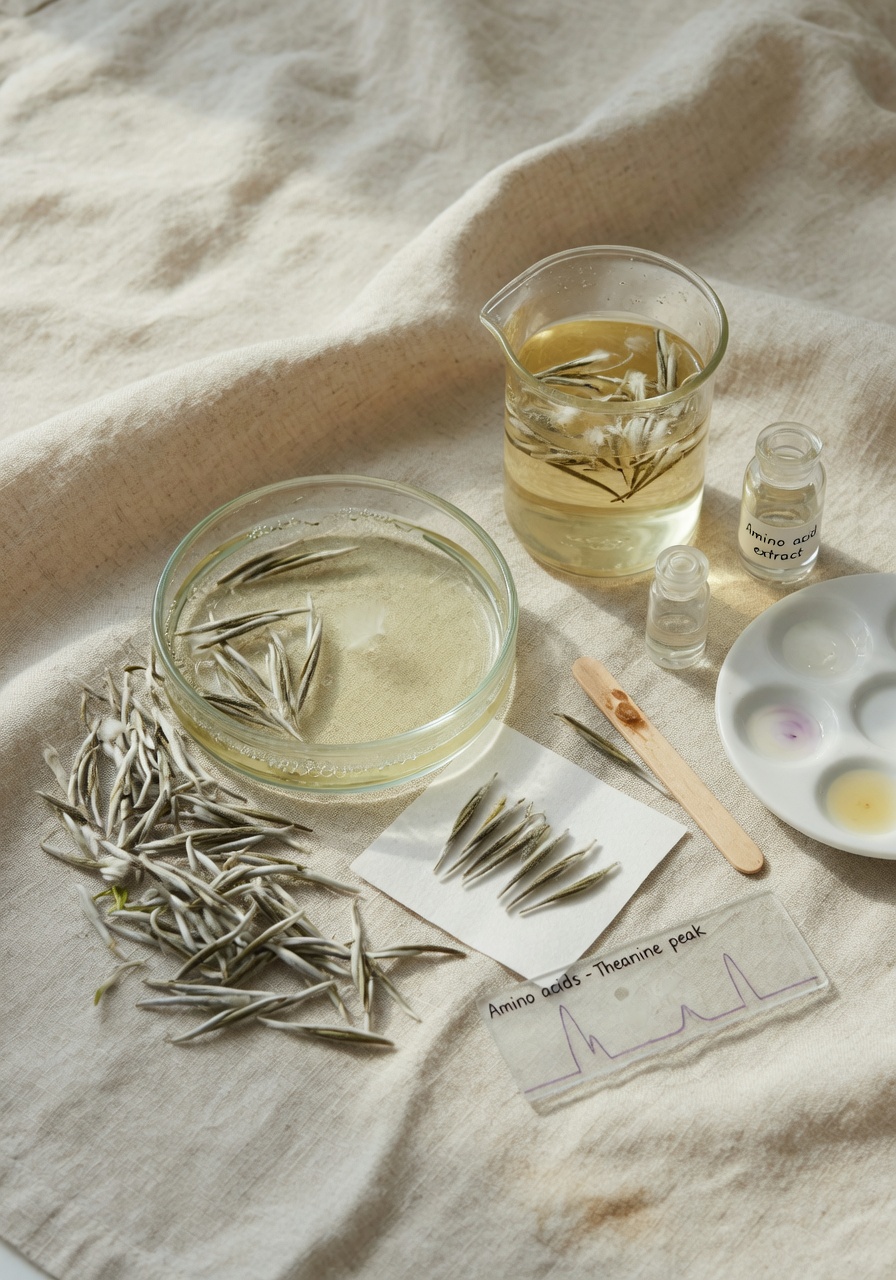
L-theanine (γ-glutamylethylamide) accounts for roughly 1–2% of the dry weight of most tea leaves and up to 50% of the free amino acid pool in the bud and first leaf. Chemically, it is a close analogue of glutamine, and its calming reputation stems partly from its ability to occupy glutamate receptors without triggering the same excitatory cascade. Electroencephalography (EEG) studies dating back to the late 1990s documented an increase in alpha-band activity within 30–40 minutes of oral administration, even at doses as low as 50 mg. That alpha rhythm is traditionally interpreted as an index of a wakeful but unstressed state — the kind of mental posture one might hope for while revising notes or sitting in a dentist’s waiting room. In the context of Chinese tea, Chen Hui Yi, Senior Tea Expert for white and green varieties, points out that “teas with a high proportion of intact buds — say, a spring-plucked Bái Háo Yín Zhēn — tend to taste most umami-forward, which is a shorthand for abundant amino acids relative to catechins.” Such teas deliver more theanine per gram of leaf than fully oxidized hong cha, but even a modestly brewed green tea will provide 6–20 mg of theanine per cup, a fraction of the doses used in most human stress studies.
The stress-reactivity hypothesis in small human trials
The core question these studies try to answer is straightforward: if someone takes theanine shortly before a controlled stressor, does the body’s physiological response look any different? The stressors are typically cognitive — a mental arithmetic test is a favourite because it reliably raises heart rate and blood pressure in a dose-response fashion — though some protocols use cold-water immersion or public-speaking tasks. Across the literature, the pattern is one of modest blunting of the sympathetic surge, but the effect size and the specific outcome variable differ from one lab to the next.
The heart-rate response under arithmetic stress
A widely cited 2007 crossover trial by Kimura and colleagues gave 12 healthy university students 200 mg of L-theanine or a placebo, then subjected them to a 15-minute mental arithmetic task. The theanine group showed a significantly attenuated increase in heart rate and a smaller spike in salivary immunoglobulin A (sIgA), a marker sometimes interpreted as an acute stress-immune indicator. The cortisol response, in contrast, did not differ between conditions, hinting that theanine was modulating autonomic outflow rather than the hypothalamic-pituitary-adrenal axis. The sample size — just 12 individuals — is emblematic of the field’s early work: underpowered for subtle effects, yet internally consistent enough to encourage replication.
Blood pressure and autonomic balance
A 2012 study by Yoto and co-workers expanded the scope to include blood pressure. Sixteen young adults received either 200 mg L-theanine, a matching dose of caffeine, or a placebo before a mental stress test and a cold pressor challenge. Theanine blunted the systolic blood pressure rise during psychological stress, while caffeine amplified it; interestingly, theanine alone did not affect heart rate under the cold pressor condition, a predominantly physical stressor. This selectivity — psychological over physical stress — suggests that the compound’s anxiolytic profile may depend on the brain’s appraisal of the threat rather than on a blanket dampening of pressor reflexes.
From cup to circulation — theanine pharmacokinetics and real-world dosing
Understanding what these trials mean for someone drinking tea requires a brief look at how theanine moves through the body. Orally ingested theanine is absorbed in the small intestine via sodium-coupled neutral amino-acid transporters, reaching peak plasma concentration at around 30–50 minutes. Its elimination half-life is roughly one hour, meaning that a single 200 mg dose is largely cleared within 4–5 hours. By comparison, a 3 g infusion of a high-theanine green tea may deliver 15–25 mg of theanine — an order of magnitude below the test doses. This gap has practical implications: the acute stress-modulating effects seen in small studies were obtained at supplement-level exposures, not at what a typical tea session provides.
Absorption and peak time
The pharmacokinetic profile is important because the timing of stress tasks in these trials is usually synchronised with the expected peak. Kimura’s group administered theanine 30 minutes before the arithmetic task, which aligns well with the known Tmax. If a tea drinker were to hope for a similar window, the cup would need to be substantial — a 6 g gongfu session might approach 30–35 mg of theanine, still far below 200 mg but sufficient to produce a detectable alpha shift in some EEG setups. Dose-response studies remain scarce, however, and the slope from mild EEG change to measurable heart-rate blunting is not yet mapped.
Theanine content in popular Chinese teas
The Chinese white tea standard GB/T 22291-2017 describes the sensory profile of top-grade white tea as ‘fresh and mellow’, a quality that many tea chemists link to elevated free amino acids. Zhao and colleagues, in a 2011 analysis of 30 Chinese green teas, found L-theanine ranges from 5.4 to 22.1 mg per gram of dry leaf, with early-spring, shade-grown, or high-altitude lots clustering at the upper end. For the tea enthusiast, the practical takeaway is that varietal choice matters: a Lóng Jǐng #43 from Xihu might yield 30 mg of theanine in a 4 g steep, whereas a coarser summer pluck may deliver half that — and neither amount is close to the 200 mg used in the classic stress trials.
Whole-leaf tea versus isolated theanine — what the studies don’t capture
Pure L-theanine is a simple molecule; a bowl of brewed tea is not. Caffeine, catechins, theogallin, and a constellation of volatile aromatics all land in the cup simultaneously, and each may push or pull on the stress response. The well-replicated observation that theanine can mute the pressor effect of caffeine — a subject we explored in our companion article on the theanine-to-caffeine ratio — suggests an interplay that is absent when the amino acid is studied alone. Moreover, the act of preparing tea — measuring the leaf, heating the water, inhaling the steam — may itself serve as a low-grade relaxation ritual, an effect that no capsule of powdered extract can replicate. A spring-harvest Anji Bai Cha, lightly steamed and steeped at 75°C, releases a broth that is almost clam-broth-sweet; that complex umami sensation is a direct expression of its amino acid abundance, which can exceed 6% of dry weight. Whether this sensory richness adds anything to the acute stress response has not been formally studied, but it almost certainly shifts the qualitative experience from ‘supplement intake’ to ‘embodied pause’.
Stress biomarkers beyond the heart — cortisol and salivary IgA
Heart rate and blood pressure are convenient, non-invasive proxies, but they do not tell the whole story of what the nervous system is doing. Researchers have therefore turned to endocrine and immune markers, with mixed results.
sIgA as a window on mucosal immunity
Salivary immunoglobulin A (sIgA) is produced by plasma cells in the salivary glands and is sensitive to acute psychological stress: a brief mental arithmetic challenge can raise sIgA concentration by 20–30% within minutes. Kimura’s 2007 trial found that theanine blunted this rise, a result that could be interpreted as a dampening of the stress-immune linkage. However, sIgA is also influenced by saliva flow rate, hydration, and time of day, and the small number of participants makes it difficult to disentangle a true pharmacological effect from individual variability.
Cortisol — the inconsistent player
Cortisol, the canonical HPA-axis hormone, has proven frustratingly inconsistent across theanine studies. While some small trials — including a 2019 investigation by Unno et al. using low-caffeine green tea in a real-world office setting — reported lower salivary cortisol in tea drinkers after sustained stress, the acute laboratory studies tend to find no significant cortisol-lowering effect of theanine alone. The discordance may reflect the nature of the stressor: an artificial arithmetic test lasts minutes, whereas workday stress accumulates over hours and may be more amenable to the cumulative, time-released absorption of theanine and other tea constituents. Until larger, longitudinal designs are adopted, cortisol will remain a biomarker of interest but not of certainty.
The weight of small samples — what the studies cannot yet tell us
The publications canvassed here share a common limitation: they are small, often single-centre trials with young, healthy populations. When a study has 12 or 16 participants, the statistical power to detect a moderate effect on a noisy variable like cortisol is low, and the risk that a few outlier responses drive the group mean is high. Publication bias is another concern — studies that find a clean, significant effect are more likely to find their way into journals, while null results sit in file drawers. Further, the stress induction methods are laboratory proxies, not the complex, multi-hour stressors of everyday life. The gap between ‘theanine blunts heart-rate rise to arithmetic’ and ‘tea reduces stress’ is therefore large, and readers are right to treat the research as a collection of intriguing leads rather than a settled conclusion. As a matter of perspective, the tea.doctor disclaimer reminds us that no individual compound or beverage should be considered a medical intervention, and that dietary choices are best discussed with a qualified health professional.
From the cup to the mind — how a well-brewed pot may complement the chemistry
Even if the pharmacological effect of a single cup is modest relative to a 200 mg capsule, the lived experience of tea offers layers that a stress trial cannot easily capture. Chen Hui Yi reflects on the interplay: “In my experience with white teas like Bái Háo Yín Zhēn, the long, slender buds produce a liquor that is both silky and light — theanine contributes to this umami sweetness, but also to a palpable calm that settles after the first few sips, especially when the tea is brewed with lower-temperature water. The ritual slows the breath before the chemistry has a chance to act.” For those who want to explore the sensory qualities that distinguish different tea types, tea.school offers guided tastings that build attention to mouthfeel, aroma, and the gentle arc of a session — a skill that may itself be a modest, repeatable practice of stress modulation.
References
- Kimura K, et al. L-Theanine reduces psychological and physiological stress responses. Biol Psychol. 2007;74(1):39-45. — Biological Psychology
- Yoto A, et al. Effects of L-theanine or caffeine intake on changes in blood pressure under physical and psychological stresses. J Physiol Anthropol. 2012;31:28. — Journal of Physiological Anthropology
- Zhao CN, et al. Simultaneous determination of seventeen free amino acids in tea by HPLC with fluorescence detection. Food Chem. 2011;127(2):724-729. — Food Chemistry
- GB/T 22291-2017. Product of geographical indication — White tea. — Standardization Administration of the People's Republic of China
- Unno K, et al. Reduced stress and improved sleep quality caused by green tea are associated with a reduced caffeine content. Nutrients. 2019;11(6):1316. — Nutrients
Read next
Related articles
نسبة الثيانين إلى الكافيين — ما قاسته الدراسات
يصل إل-ثيانين إلى الدماغ. الكافيين يوقظه. السؤال المثير للاهتمام ليس ما إذا كان كل منهما يعمل بمفرده، بل ما تفعله النسبة بينهما — وما اختبرته تصاميم التجارب فعليًا.
Theanine during exam preparation — the cognitive literature
L-theanine, the amino acid that makes tea calming, has caught the attention of students worldwide. We comb the literature to see what’s really measured — and what’s still guesswork.
Tea late at night — what it does to sleep architecture
Does a late-night pot of tea guarantee a restless night? Research on caffeine's half-life and theanine's calming influence suggests the answer depends on the leaf — aged whites and fermented pu'er may shift the balance in unexpected ways.