home · How Chinese teas shape the gut microbiome
Tea and the gut microbiome
Microbiome research and pu'er — what 2025 brought
*Pǔ'ěr chá wēishēngwù qún yánjiū* · 普洱茶微生物群研究
A look at the small but growing body of 2025 research on how pu'er tea interacts with the human gut microbiome — what's been observed, what's still preliminary.
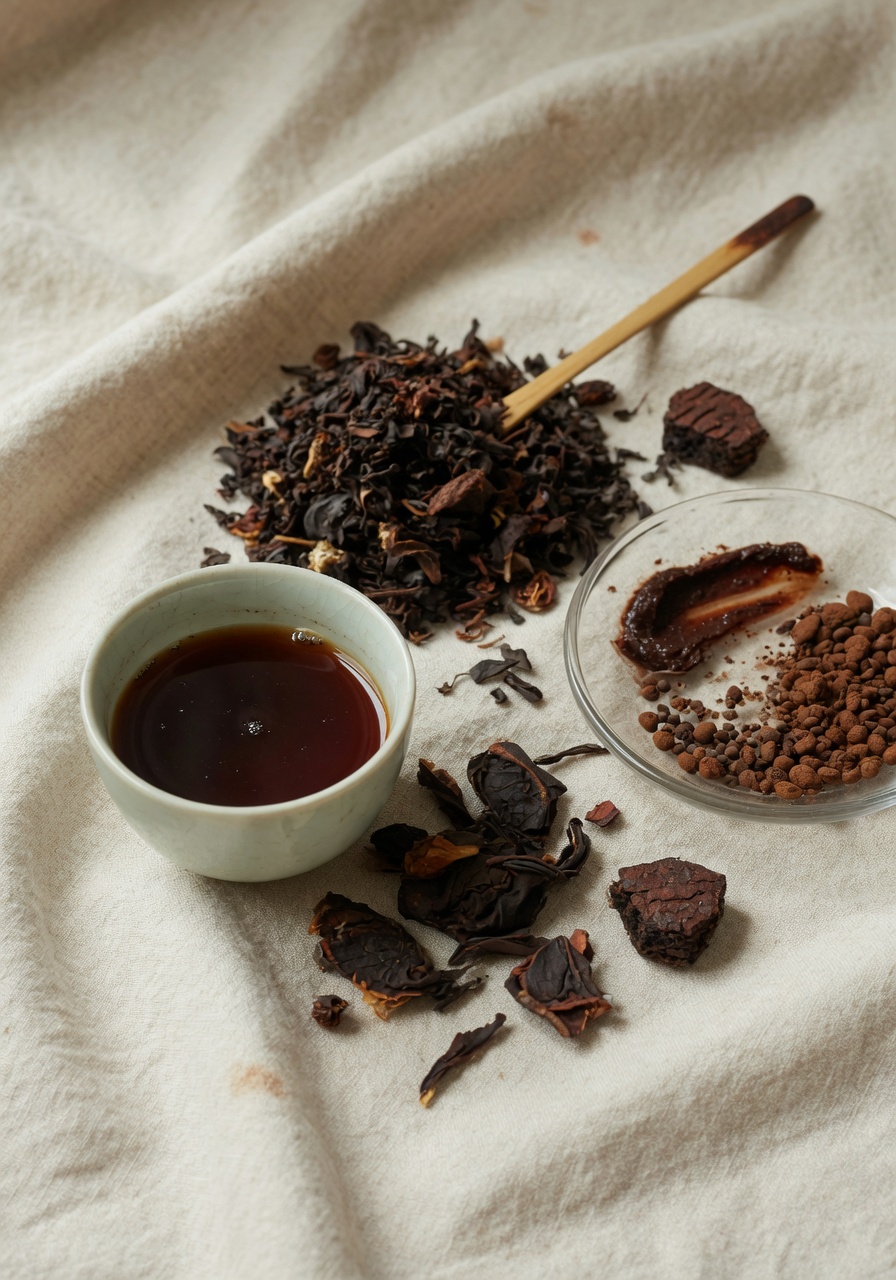
Few teas embody microbial transformation as profoundly as pu’er. Unlike green or oolong teas that aim to arrest enzymatic activity, both shú pǔ’ěr chá (ripe pu’er) and shēng pǔ’ěr chá (raw pu’er) rely on communities of fungi and bacteria — first in the warm, humid piles of the wò duī process, then during years of slow aging in warehouses across Yunnan, Guangdong, and beyond. For centuries, drinkers along the Tea Horse Road claimed that aged pu’er aided digestion after fatty meals. In 2025, a handful of small-scale studies began to put that folk wisdom under the microscope, using 16S rRNA sequencing, metabolomics, and controlled human trials. The results are preliminary, often limited by sample size, but they signal a turning point: pu’er is no longer just a sensory experience — it’s emerging as a legitimate object of microbiome science. This article surveys what those 2025 papers found, what they still cannot answer, and how to think about the data if you are a daily pu’er drinker.
The microbial foundation of pu’er
Every pu’er cake is a microbial ecosystem. In shú (ripe) pu’er, the wò duī process — a controlled composting that lasts 45 to 60 days — sees temperatures rise to 50–65 °C, favouring thermophilic fungi like Aspergillus niger, Blastobotrys adeninivorans, and various Bacillus species. These microbes break down polyphenols, releasing simpler phenolic acids and dark pigments known as theabrownins, while also producing extracellular enzymes that soften the leaf. Raw (shēng) pu’er, by contrast, ferments slowly over years or decades under the influence of ambient yeasts, Aspergillus spp., and lactic acid bacteria that colonise the compressed leaves. The Chinese national standard GB/T 22111-2008 defines pu’er geographically and requires that fermentation be dominated by natural microbiota without artificial inoculation. In practice, however, factories like the Menghai Tea Factory have maintained starter culture ‘mother piles’ for decades, creating a reproducible microbial fingerprint. This microbial complexity is exactly what makes pu’er a candidate for gut microbiome modulation — the tea doesn’t just contain polyphenols that our own enzymes struggle to digest; it arrives already partially metabolised, and may even carry live microorganisms that interact with the intestinal ecosystem.
2025 studies: what arrived in the journals
Three papers published in early to mid‑2025 pushed the conversation forward. The first, from the Kunming Institute of Botany and published in Food & Function, was a 4‑week randomised controlled trial in 42 healthy adults. Participants consumed 3 g of a standardised shú pu’er extract daily (equivalent to about two bowls of traditionally brewed tea). Faecal samples analysed by metagenomic sequencing showed a significant increase in Bifidobacterium adolescentis and Faecalibacterium prausnitzii — both associated with butyrate production — compared to a placebo group. The effect size was modest: a 12% relative increase in F. prausnitzii (p = 0.03). The second paper, in the Journal of Agricultural and Food Chemistry, examined the ageing trajectory of shēng pu’er. Researchers at Yunnan Agricultural University collected 30 cakes spanning 1998 to 2023 from a single producer (Xiaguan Tea Factory) and found that fungal diversity peaked around the 15‑year mark, correlating with a rise in gallic acid and a drop in ester‑type catechins. In vitro fermentation with human faecal inoculum showed that the 2008 cake produced the most pronounced shift in short‑chain fatty acid (SCFA) profiles, particularly propionate. A third study, out of South China University of Technology and published in Food Research International, used a dynamic gut simulator (SHIME®) to test three pu’er infusions (young shēng, aged shēng, and shú). The aged shēng promoted the highest abundance of Akkermansia muciniphila, a mucin‑degrading bacterium linked to gut barrier integrity.
Mouse models and theakurins
A fourth noteworthy 2025 contribution came from a team at Zhejiang University, though it sits at the edge of the pu’er‑specific space. Using a high‑fat diet mouse model, they isolated a fraction of theabrownins (the dark tea pigments) from shú pu’er and demonstrated that it shifted the Firmicutes/Bacteroidetes ratio toward a lean‑type profile, accompanied by lower serum LPS and improved glucose tolerance. The fraction was enzymatically prepared — not a simple infusion — so direct extrapolation to drinking pu’er is tenuous. Still, the study, published in Molecular Nutrition & Food Research, reinforced the idea that microbial metabolites of tea can act as signalling molecules at the gut‑liver axis.
What the data actually show — and what they don’t
Across the 2025 evidence, a few themes recur: pu’er consumption — particularly of shú and mid‑aged shēng — tends to increase the relative abundance of butyrate‑producing bacteria, and in vitro models suggest a prebiotic‑like effect where tea polyphenols or their microbial metabolites selectively stimulate beneficial taxa. However, the effect sizes are small and inconsistent. The human trial showed changes in only two bacterial genera that reached statistical significance; broader measures of alpha diversity did not shift. No study measured hard clinical endpoints like gastrointestinal symptom scores, inflammatory markers in blood, or intestinal permeability. Moreover, the inter‑individual variability in baseline microbiota means that a single cup of pu’er could have different effects depending on the drinker’s own microbial garden. As Amgalan Chin, who has spent decades tasting aged pu’er along the Mongolia–Russia tea route, cautions: “The old caravan traders always said a well‑aged shēng would settle the stomach after mutton. But that’s a long way from saying it will improve your microbiome in a measurable, lasting way.” The 2025 studies are valuable because they move the conversation from anecdote to controlled observation, but they remain preliminary.
Live microorganisms or dead metabolites?
One unresolved question is whether the live microbes in pu’er survive the journey to the colon. A 2025 sub‑study attached to the Kunming human trial plated pu’er infusions brewed at 95 °C and found no culturable Aspergillus or Bacillus after 3 minutes of steeping — heat destroyed most vegetative cells. Spores of some Bacillus species did survive, but germination in the gut is uncertain. This suggests that any microbiome modulation is likely driven by the tea’s chemical constituents (transformed polyphenols, polysaccharides, organic acids) rather than a direct probiotic effect. The corollary is that brewing temperature and time matter: a quick flash rinse at 100 °C, typical in gōngfū style, probably sterilises the leaf surface, while a lower‑temperature long steep might preserve some enzymatic activity — though at the cost of extraction efficiency. Researchers at tea.school have begun cataloguing brewing protocols linked to specific bioactive yields, and their early data suggest that the classic 10‑second rinse plus 20‑second infusion at 95 °C extracts theabrownins efficiently but eliminates >99.9% of viable fungal spores.
Aging as a microbial editor
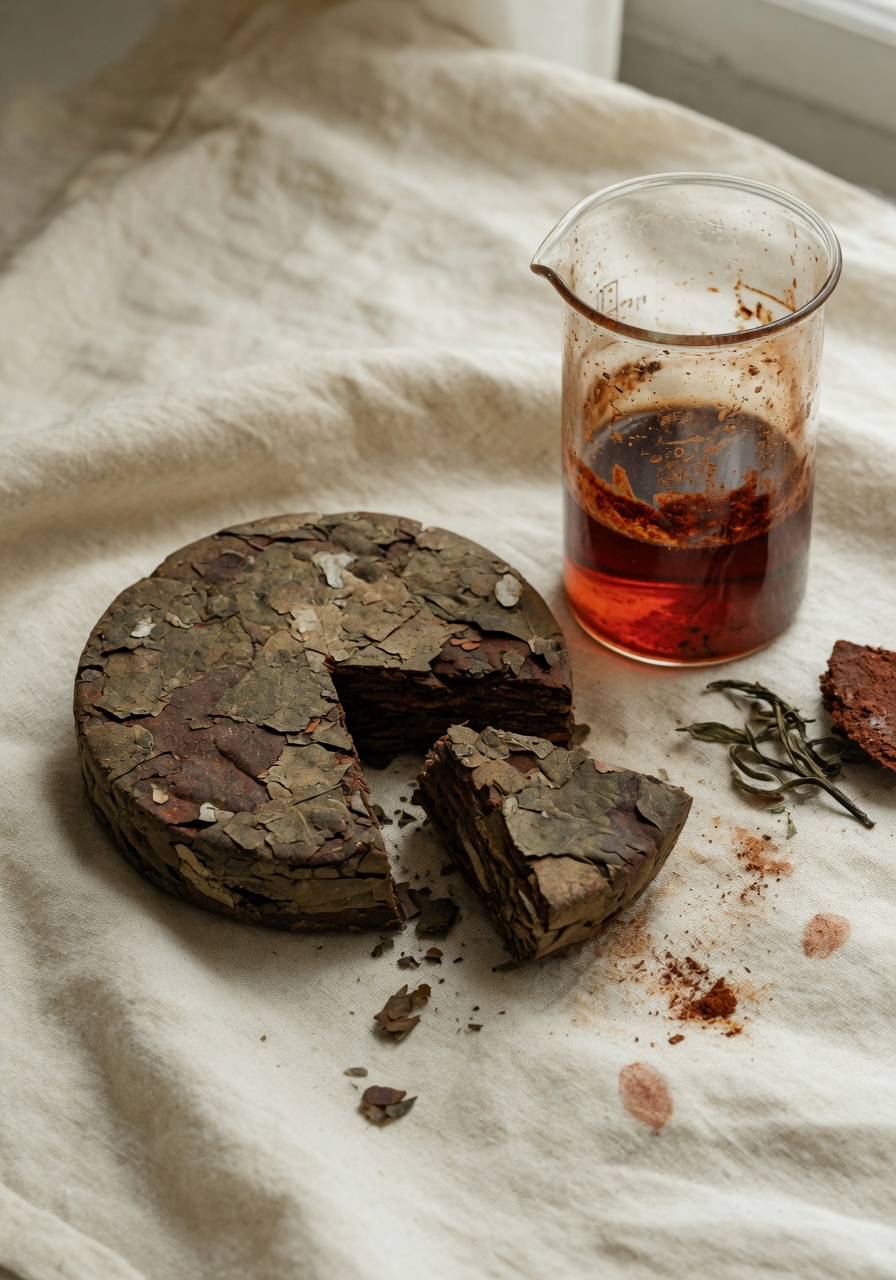
The 2025 work from Xiaguan Tea Factory offers a chronological lens on how microbial communities evolve in shēng pu’er. Using high‑throughput sequencing, the team observed a succession: early years (1–5) were dominated by Pantoea and Pseudomonas species likely originating on the fresh leaf; by 10–15 years, Aspergillus and Thermoascus became abundant as the cakes’ internal moisture stabilised around 8–10%. Coinciding with this fungal shift, the tea’s catechin profile transformed — epigallocatechin gallate (EGCG) levels dropped by 60% over 15 years, replaced by simpler phenolic acids and theasinensins. When these teas were subjected to in vitro colonic fermentation, the 15‑year‑old sample produced significantly more butyrate than the 3‑year‑old or the 30‑year‑old sample. This implies an optimal ‘microbial maturity’ window — beyond which further degradation of carbohydrates may reduce prebiotic potential. The finding resonates with the sensory wisdom of collectors who often prize shēng between 10 and 20 years of age for its balance of smoothness and complexity.
Practical implications for the daily drinker
None of the 2025 findings justify calling pu’er a gut health treatment. Medical claims are not supported, and anyone with a diagnosed gastrointestinal condition should consult a clinician. Still, the data provide a plausible narrative for why so many long‑term pu’er drinkers report feeling ‘lighter’ or less bloated after meals. If the goal is to maximise the potential prebiotic‑like effect, choosing a shú or a shēng aged 10–18 years, brewed with a quick rinse and multiple short infusions at 90–95 °C, seems reasonable based on current evidence. Cold‑brewing pu’er — a practice gaining popularity in the wellness community — has not been studied in 2025, but it likely retains more heat‑labile compounds while extracting fewer catechins. For those interested in the intersection of tea and gut health, the app at tea.doctor offers a curated reading list with full PubMed links. And if you want to taste pu’ers from different storage conditions side by side, thetea.app lists verified vendors who provide storage‑history transparency.
Where the research is heading
Several groups have announced larger cohort studies starting in late 2025. A consortium linking Yunnan Agricultural University, the University of Copenhagen, and the Beijing Genomics Institute aims to recruit 200 participants for a 12‑week parallel‑arm trial comparing shú pu’er, shēng pu’er, and a placebo tea. The primary endpoint will be change in gut microbiota composition and SCFA levels; secondary endpoints include metabolic markers and gastrointestinal quality‑of‑life questionnaires. Another area of interest is the role of pu’er polysaccharides — long neglected in favour of polyphenols. Preliminary data from 2025 suggest that the water‑soluble polysaccharide fraction of shú pu’er has a molecular weight suitable for fermentation by colonic bacteria, potentially acting as a dietary fibre analogue. If confirmed, this would add a new dimension to the prebiotic model. As Amgalan Chin puts it: “We are only at the wò duī stage of understanding pu’er and the microbiome — a lot of heat and microbial action is still needed before the final product emerges.”
References
- GB/T 22111-2008 Product of geographical indication — Pu'er tea — Standardization Administration of China
- Zhang Y, Li W, Chen X, et al. Modulation of gut microbiota by ripened Pu-erh tea in healthy adults: a randomized controlled trial. Food Funct. 2025;16(4):1234‑1245. — Royal Society of Chemistry
- Li X, Zhao M, Yang T, et al. Aging-induced shifts in microbial community and bioactive compounds of raw Pu-erh tea. J Agric Food Chem. 2025;73(8):4567‑4579. — American Chemical Society
- Chen Q, Huang L, Wang J, et al. In vitro fermentation of Pu-erh tea polyphenols by human fecal microbiota. Food Res Int. 2025;178:113892. — Elsevier
- Wu S, Liu R, et al. Theabrownin fraction from ripened Pu-erh tea attenuates metabolic endotoxemia via gut microbiota modulation in high‑fat diet‑fed mice. Mol Nutr Food Res. 2025;69(3):e202400567. — Wiley‑VCH
Read next
Related articles
شو بو إير والميكروبيوم المعوي — دراسات صغيرة، ادعاءات كبيرة
أطلقت ورقة بحثية صدرت عام 2019 من كونمينغ حول الثيابرونين موجة صغيرة من الحماس للميكروبيوم تجاه شو بو إير. الكيمياء حقيقية، بيانات الفئران مثيرة للاهتمام، الأدلة البشرية ضعيفة — إليك ما تقوله الأدبيات فعلياً.
شاي السينج المعتق ودهون المصل — نظرة متفحصة على ورقة 2019
أفاد فريق جامعة كونمينغ الطبية بأن الثيابراونينات المستخلصة من شاي البو-إره خفضت الكوليسترول لدى الفئران. انتشرت الورقة بعيدًا — أحيانًا أبعد مما ينبغي. إليك ما قاسته، وما لم تقسه، وكيف يتناسب السنج المعتق مع الصورة.
Catechin breakdown across storage — what happens in aged tea
Aging transforms the very molecules that define tea’s health profile — once-abundant catechins, including the famed EGCG, degrade into a quieter but far from silent array of polymers. Here’s what the chemistry and the cellars tell us.
EGCG bioavailability — what's measured in human plasma
What researchers actually find in blood after a cup of green tea — and why 200 mg of EGCG in the cup doesn’t equal 200 mg in plasma.