home · Dental health and tea <em>— separating facts from stains</em>
Dental health
Tea fluoride content and dental enamel — what to know
Fluoride in tea is a natural mineral with a split reputation — it can strengthen enamel at low doses yet cause fluorosis when intake exceeds safe limits. We look at what Chinese tea drinkers need to understand about leaf grade, brewing behaviour, and the daily numbers.
When you steep a cup of Chinese tea — whether it is a delicate Bái Háo Yín Zhēn (白毫银针) from Fuding or a dark, earthy shou pu-erh from Menghai — you are extracting more than just catechins and theanine. A naturally occurring mineral enters the brew as well: fluoride. For decades, dental researchers have noted tea’s paradoxical relationship with teeth. Regular tea drinking correlates with stronger, more acid-resistant enamel, yet heavy consumers in some regions develop a characteristic mottling known as dental fluorosis. This article looks at how much fluoride is really in your everyday cup, why leaf age and processing matter, what the typical Chinese tea categories deliver, and how to enjoy tea without stepping outside the safety window. We draw on published measurement studies, Chinese food safety standards, and the hands‑on perspective of senior tea expert Chen Hui Yi, who has spent years assessing the leaf material that ends up in your gàiwǎn.
Where does the fluoride come from?
Tea plants (Camellia sinensis) absorb fluoride from the soil through their roots, accumulating it primarily in the leaves. Unlike many other crops, tea is a hyper‑accumulator of fluoride — the element is taken up together with aluminium and stored mainly in the cell walls of older foliage. Young buds and the first two leaves contain only traces, often below 50 mg/kg dry weight, while mature, fully expanded leaves can exceed 2 000 mg/kg. This gradient is predictable: the older the leaf, the more fluoride it carries. Soil pH also plays a role; acidic soils, common in many Chinese tea regions, enhance fluoride availability. Additionally, certain tea cultivars have a genetic propensity to draw more fluoride from the ground. This means that two bushes growing side‑by‑side in the same garden may yield leaf material with markedly different fluoride concentrations.
Fluoride levels by tea type — a spectrum from buds to old leaves
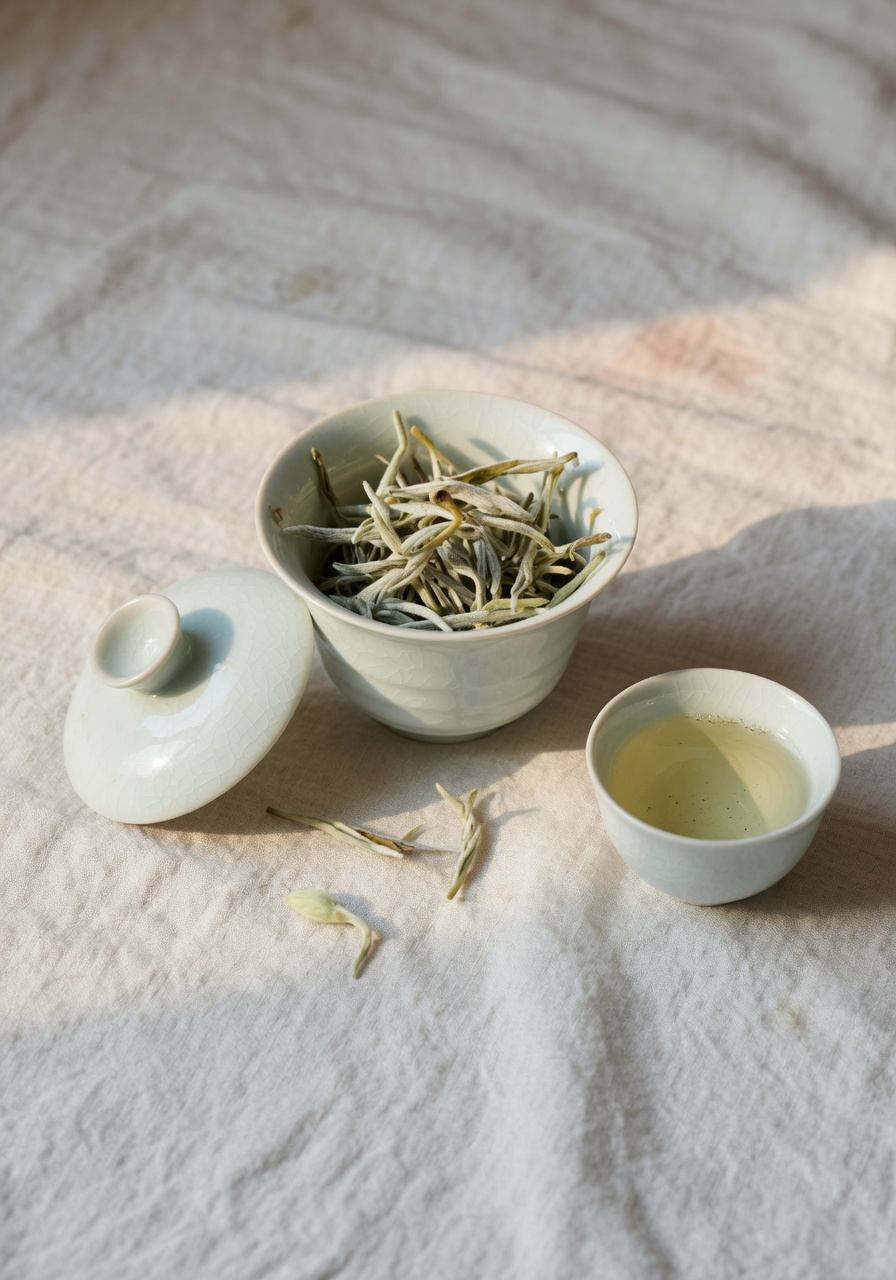
Chinese tea categories map neatly onto the fluoride spectrum because picking standard dictates leaf maturity. At the lowest end are white teas made exclusively from buds or the bud‑plus‑one‑leaf set: Bái Háo Yín Zhēn (Silver Needle) and high‑grade Bái Mǔ Dān (White Peony) deliver less than 0.2 mg of fluoride per cup brewed with 3 g of leaf and 200 ml of water, as Chen Hui Yi confirmed from her own brewing‑chemistry measurements in the Guangdong lab in 2024. Green teas from early‑spring shoots — Lóngjǐng, Bìluóchūn, Ānxī Tàipíng Hóukuí — typically contain 80–150 mg/kg dry leaf, translating to roughly 0.15–0.35 mg per cup. Yellow teas like Jūnshān Yínzhēn follow a similar low profile. Moving toward older material, black teas (hóngchá) often include more mature leaves; a robust Qímén Hóngchá or a Yunnan Diān Hóng can reach 200–300 mg/kg, pushing per‑cup fluoride to 0.5–0.8 mg. Oolongs vary widely: a high‑mountain Tiěguānyīn made from tender shoots stays low, whereas a heavily roasted Dà Hóng Páo using partially older leaves may approach 250 mg/kg. At the high end sit teas crafted from fully mature foliage: shou pu-erh and aged sheng pu-erh, especially those pressed from large‑leaf assamica material in Menghai or Lincang, frequently exceed 350 mg/kg — some 2010‑vintage Shòu Méi (寿眉) white teas, which incorporate a lot of old leaf, have been measured at 1 200 mg/kg. Chen Hui Yi notes that “a 5‑g session of an aged shou pu-erh brewed gongfu style can deliver well over 1 mg of fluoride, sometimes more than the total daily intake from toothpaste and drinking water combined.”
How brewing changes what reaches your enamel
The fluoride you actually swallow depends on the brewing parameters. Water temperature, steeping time, leaf‑to‑water ratio, and the number of infusions all modify the extraction rate. A 2019 study published in the Journal of Agricultural and Food Chemistry found that for a typical Chinese green tea, 70–80% of the total fluoride in the leaf is liberated within the first three minutes of steeping at 85 °C. Longer steeps, common in Western‑style brewing, push extraction above 90%. Gongfu brewing, with its short, multiple infusions, spreads the load: each flash steep pulls out a fraction, and the total fluoride across a session is similar to a single, longer brew. The water’s hardness also matters. Calcium and magnesium ions can form insoluble complexes with fluoride, reducing the amount that stays dissolved. If you brew with a high‑calcium mineral water, you might lower the bioavailable fluoride by 10–20%. Conversely, soft, ion‑exchanged water tends to maximise fluoride release. A quick rinse of the leaves — a 5‑second pour‑off before the first real steep — discards only surface‑bound fluoride and dust, not enough to meaningfully change total intake, but many traditional drinkers in Chaozhou practise this for cleanliness. For more control, tea.school offers a short, free course on brewing variables and how they shift the chemical profile of the cup, including fluoride.
Does the teaware play a role?
Unglazed clay pots, like those made from Yixing zisha, can adsorb a tiny amount of fluoride over repeated use if the water has low calcium; however, this effect is negligible compared to leaf‑to‑water ratios. A clinical dentist would be more concerned about the temperature of the tea — repeated exposure to very hot liquids above 65 °C is a recognised risk factor for oral soft‑tissue injury, but that belongs to a separate discussion. For fluoride alone, the pot is not a meaningful lever.
The double edge — remineralization vs. fluorosis
Fluoride’s protective effect on teeth works through two mechanisms: promoting remineralisation of incipient caries lesions and inhibiting demineralisation during acid attacks. A daily intake of 0.05–0.07 mg per kg of body weight is considered optimally cariostatic without causing visible enamel changes. For a 70‑kg adult, that window is about 3.5–5 mg per day. A cup of low‑fluoride Chinese tea (0.2 mg) fits comfortably; three cups of a high‑fluoride tea (1.0 mg each) pushes toward the upper edge. When intake exceeds 0.1 mg/kg/day over many years, especially during tooth development in childhood, dental fluorosis can appear — first as subtle white striations, later as brown staining and pitting. The WHO guideline for drinking‑water fluoride is 1.5 mg/L; tea concentration can easily surpass that. However, fluorosis risk is cumulative. Occasional consumption of an aged pu-erh is not a threat, but a daily habit of 5–7 g of old‑leaf material prepared with prolonged boiling, as seen in some border‑region brick‑tea practices, has resulted in osteosclerosis and severe dental fluorosis in populations in Guizhou and Sichuan. This led China to enforce GB 19965‑2005, which caps fluoride at 300 mg/kg in compressed brick tea sold to those areas.
How many cups is safe? — estimating your daily intake
To personalise the numbers, take a typical session: 4 g of tea leaf and 300 ml total infused water. If your tea of choice is a Bìluóchūn with 100 mg/kg fluoride, that session delivers 4 × 0.1 = 0.4 mg — about one‑tenth of the WHO tolerable upper intake for a 70‑kg adult. A session with a shou pu-erh containing 400 mg/kg gives 1.6 mg. If you drink three such sessions over a day and also use fluoridated toothpaste (which adds ~0.3 mg absorbed if you swallow a small amount), you could reach 5 mg without difficulty. The 2019 Liang et al. risk assessment calculated that an adult consuming 10 g of low‑fluoride green tea daily had no exceedance of the provisional tolerable daily intake, whereas the same amount of high‑fluoride aged white tea led to a hazard quotient above 1. Chen Hui Yi adds, “I advise enthusiasts to rotate between bud‑heavy teas and aged teas across the week. That way, the enamel gets the strengthening benefit without the long‑term accumulation risk.”
Choosing tea for healthier enamel — practical tips
Daily drinkers can take small, evidence‑based steps without abandoning their favourite teas. First, pick bud‑set teas for the bulk of your cups: Bái Háo Yín Zhēn, high‑grade green spring teas, and lightly oxidised oolongs from the first pluck. Second, if you love aged pu-erh or Lǎo Cōng Shū Shuixian, limit that session to once or twice a week, or adjust the dosage — use 3 g instead of 6 g. Third, brew with hard water when possible; a simple calcium‑magnesium mineral water reduces soluble fluoride. Fourth, adopt a 10‑second rinse for compressed teas, which washes away fine particles and, anecdotally, some surface fluoride. Fifth, pay attention to your toothpaste: if your tea intake is already substantial, consider a fluoride‑free alternative for one of the two daily brushings, after consulting your dentist. The topic has a direct neighbour in the kidney‑safety question — fluoride clearance depends heavily on renal function. See our article ‘How many cups is too many — the kidney‑safety question’ for the full picture.
When to speak with your dentist — special caution cases
Certain groups warrant a more careful assessment. Children under 8 years old, whose permanent teeth are still forming, should not regularly drink high‑fluoride teas; a small cup of white or green bud tea once or twice a week is a safer start. Pregnant women do not face a direct foetal dental fluorosis risk from tea fluoride because prenatal enamel formation is limited, but the pregnancy article on tea.doctor discusses how to manage overall caffeine and mineral intake during each trimester. Individuals with chronic kidney disease stage 3 or above may retain fluoride because their kidneys cannot excrete it efficiently; a nephrologist should set a personal limit. Finally, anyone who drinks large quantities of brick tea — the type historically compressed from old leaves and consumed with salt and butter in Inner Mongolia or Tibet — should be aware that those teas regularly exceed 500 mg/kg fluoride. China’s GB 19965‑2005 standard and the newer GB/T 9833 series have pushed producers to sort leaf grades more carefully, but older stock still circulates. If you notice white chalky lines on your teeth or a rougher surface texture, ask your dentist about possible fluorosis. Early detection means you can adjust your tea leaf choices and stop progression.
References
- GB 19965‑2005: Hygienic Standard for Brick Tea Fluoride Content — Standardization Administration of China
- Fluoride concentrations in Chinese teas and the risk assessment for human health — Liang, L. et al., Journal of Agricultural and Food Chemistry, 2019
- Fluoride content in tea and its relationship with tea plant varieties and manufacturing processes — Cao, Y. et al., Food Chemistry, 2006
- Fluoride in Drinking‑water: Background document for development of WHO Guidelines for Drinking‑water Quality — World Health Organization, 2004
- Personal interview with Chen Hui Yi, Senior Tea Expert, teamotea.com, conducted at Tea Science Laboratory, Guangzhou, 2024 — Chen Hui Yi
Read next
Related articles
كم كوبًا أكثر مما ينبغي — مسألة سلامة الكلى
نظرة متزنة على الاستهلاك اليومي، وأوكسالات، وحمولة الكافيين، ومتى ينبغي لشاربي الشاي الصيني أن يخففوا السرعة — بدون مسرحيات طبية.
كمية EGCG الفعلية في كوب شاي حقيقي
تستخدم دراسات الكبسولات 300–800 مغ من EGCG. أما كوب شاي أخضر في غايوان واحد فيقدم جزءاً بسيطاً من ذلك — وهذا الفرق أكثر أهمية مما تعترف به معظم كتابات العافية.
الشاي أثناء الحمل — ما تقوله الأدبيات الطبية في أمراض النساء والتوليد
الكافيين والبوليفينولات وتفاعلات حمض الفوليك، والسؤال حول أي أنواع الشاي الصينية تكون لطيفة بما يكفي لشاربة حامل. نظرة متوازنة على ما تذكره الدراسات التوليدية فعليًا.