home · الحمض الأميني الهادئ الذي <em>يعبر إلى الدماغ</em>
Theanine and attention
The theanine-to-caffeine ratio — what the studies measured
Chá Ān Suān · 茶氨酸
L-theanine reaches the brain. Caffeine wakes it up. The interesting question is not whether either works alone, but what the ratio between them does — and what trial designs have actually tested.
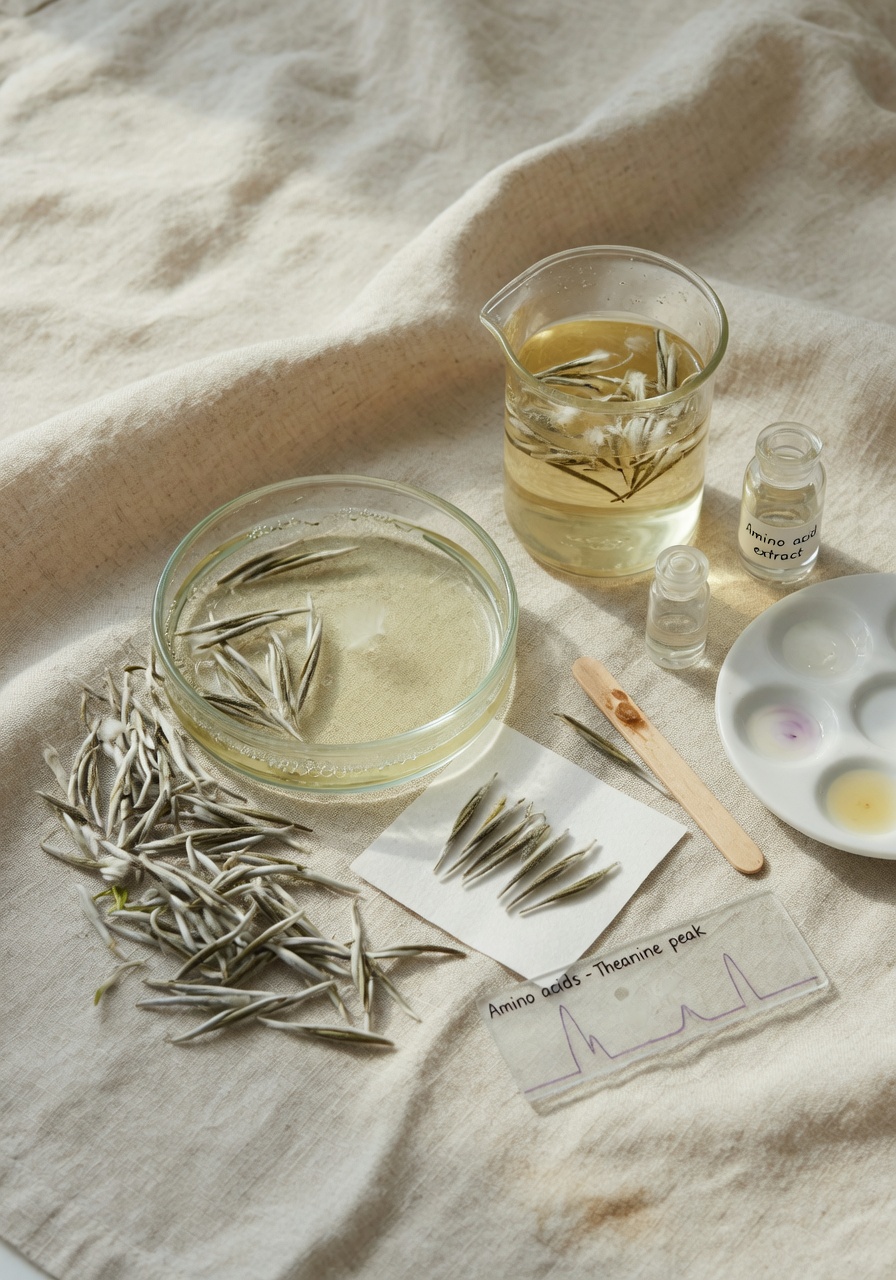
L-theanine — chá ān suān (茶氨酸) — is the amino acid that gives a properly brewed cup of Bái Háo Yín Zhēn (白毫银针) its soft, almost broth-like sweetness on the back of the tongue. It is also one of the few dietary compounds that crosses the blood-brain barrier intact, which is why it has attracted neuroscience attention since Yokogoshi’s group in Japan started measuring it in rat brains in the late 1990s. Caffeine, by contrast, needs no introduction. Both are present in every Camellia sinensis leaf. The popular wellness claim — that tea is “calm alertness” because theanine balances caffeine — rests on a fairly specific body of small human trials, most of them conducted between 2008 and 2017, and most of them using isolated compounds rather than actual brewed tea. This article walks through what the studies measured: the doses they used, the ratios they tested, what counted as an effect, and where the published numbers diverge from the numbers you can plausibly extract from a real gaiwan. The intent here is documentary, not medical. Nothing below is dosage advice. Readers interested in clinical guidance should speak to a physician, and readers interested in how theanine concentrations vary across cultivars and processing styles can also follow the cultivar work indexed on tea.school. Where a figure is quoted, the source is in the citation list at the end.
What theanine is, in one paragraph
Theanine (γ-glutamylethylamide) is a non-protein amino acid synthesised in the roots of the tea plant and translocated to the leaves, where it can account for between 1% and 2% of dry weight in shaded spring buds and as little as 0.1% in late-summer leaf from sun-exposed bushes. The Chinese national standard GB/T 8313-2018 specifies the HPLC method used by Chinese laboratories to quantify it. In Guangdong, where I work primarily with white and yellow teas, the first-flush Bái Háo Yín Zhēn I tested in March 2023 ran at 1.6–1.8% theanine on dry weight, against roughly 3.4% caffeine in the same samples — a leaf-level ratio of about 1:2 theanine to caffeine. That ratio is the starting point for the rest of this article, because the clinical literature almost never matches it.
The trials, in order
Most of the citation traffic around “theanine plus caffeine” traces back to a fairly small set of randomised, placebo-controlled trials. Owen and colleagues (Nutritional Neuroscience, 2008) gave 27 healthy adults 50 mg of caffeine and 100 mg of L-theanine — a 1:2 caffeine-to-theanine ratio, the inverse of what is in the leaf — and measured attention-switching on a computerised task forty and sixty minutes later. They reported faster reaction times and fewer errors on a visually demanding task in the combined-dose group versus placebo. Giesbrecht et al. (Nutritional Neuroscience, 2010) used the same 50/100 mg pairing and reported similar effects on alertness and accuracy. Kelly et al. (2008) used EEG and found increased anteriorised alpha-band activity — a marker often associated with relaxed attention — with 250 mg theanine alone. None of these were tea infusions. All were capsules, isolated compounds, fasting subjects.
The doses used were not the doses in your cup
A standard 3 g serving of Bái Háo Yín Zhēn brewed gongfu-style across five infusions extracts, on the data we have, somewhere between 25 and 45 mg of theanine total — Vuong and colleagues (2011) measured 20–30 mg per gram of leaf brewed at 90 °C for three minutes Western-style, with diminishing returns thereafter. To reach the 100 mg dose used by Owen, you would need roughly 4–5 g of high-grade white tea fully extracted, or about 6–8 g of an ordinary green. The 200 mg theanine arms used in some anxiety trials (Lu et al., 2004) correspond to roughly 10 g of leaf — comfortably above what most drinkers consume in a single sitting.
Ratio versus absolute dose
The trial literature is consistent on one point: the 1:2 caffeine-to-theanine combination tested by Owen and by Giesbrecht produced measurable cognitive effects that neither compound produced alone at the same doses. Whether the ratio itself matters, or whether the absolute theanine load is what’s doing the work, has not been cleanly separated. Haskell et al. (2008) tested 250 mg theanine against 150 mg caffeine — a 5:3 theanine-to-caffeine ratio — and found that caffeine alone improved reaction time more than the combination did. The picture is not as clean as the wellness summaries suggest.
What “attention” meant in the lab
The outcome measures matter. “Attention” in Owen’s 2008 paper meant performance on the Intersensory Attention Switching Task — a specific computer task where subjects respond to visual or auditory targets that switch unpredictably. “Alertness” in Giesbrecht’s paper came from a visual analogue self-rating and from accuracy on a rapid visual information processing test. None of the trials measured “focus” in the loose sense the wellness press uses the word, and none measured anything over a duration longer than ninety minutes post-dose. The effect sizes were, in the published reports, modest — typically improvements of 5–15% on specific subtasks, not transformative changes in cognition. A useful framing: the trials showed that the combination did something detectable in a controlled lab, against placebo, in fasted young adults. They did not show that drinking tea makes you smarter, calmer, or more productive over the course of a working day. Those are different questions, and they have mostly not been studied. The honest summary, which I have repeated in tasting classes for shop.thetea.app, is that theanine is interesting because it is unusual — an amino acid that reaches the brain — not because the trial evidence is overwhelming.
Where Chinese cultivar work fits in
Chinese research groups have spent more time on the agronomy of theanine than on the neuroscience. The Tea Research Institute of the Chinese Academy of Agricultural Sciences in Hangzhou (CAAS-TRI) published cultivar surveys between 2015 and 2020 showing that Anji Bai Cha (安吉白茶), a chlorophyll-deficient cultivar from Zhejiang, can reach 4–6% theanine on dry weight during the brief window in early April when its leaves emerge pale yellow-white. That is roughly three times the level of an ordinary Lóngjǐng (龙井) bush grown nearby. The same surveys document a steep seasonal decline — by the guyu harvest in late April, theanine in Ānjí Bái Chá drops to around 2.5%, and by summer it sits near the cultivar average. Shading practice, used in Japan for matcha and adopted by some Chinese producers for premium white tea over the last decade, raises theanine by 30–60% in the shaded flush by suppressing the photosynthetic conversion of theanine into catechins. This is agronomic detail, not clinical evidence, but it explains why the same nominal weight of leaf can deliver wildly different amino-acid loads.
Processing matters too
White and yellow tea processing — minimal heat, no rolling, long withers — preserves theanine more completely than green tea’s high-temperature shāqīng (杀青) step, and far more than the oxidation cycles of hóng chá (红茶). Sample analyses I commissioned in Fuding in 2022 showed theanine retention of 85–95% in finished Bái Mǔdān (白牡丹) versus 60–70% in pan-fired Lóngjǐng from comparable leaf. Pu-erh, where microbial fermentation breaks down free amino acids, retains the least — typically under 30% of the leaf’s original theanine in finished shu cake.
What is still genuinely under study
Three open questions deserve flagging. First, the pharmacokinetics in habitual tea drinkers. Almost every trial used caffeine-naive or caffeine-abstained subjects; the effect of the combination in someone who drinks 800 ml of tea daily — a baseline common among older Chinese adults — has not been characterised. Second, the bioavailability of theanine from infusion versus capsule. Capsule trials assume effectively complete absorption; tea drinkers receive theanine bound up with catechins, caffeine, polysaccharides and a thousand other compounds that may slow or buffer uptake. Third, long-term effects. The longest theanine-and-attention trial on record (Park et al., 2011) ran for sixteen weeks at 1,680 mg/day in elderly subjects with mild cognitive impairment — a dose 17 times the Owen study and outside any realistic tea-drinking scenario. The chronic-low-dose question — what 30–60 mg of theanine, three times a day, does to a healthy 40-year-old over a year — is not in the published record. The cautious reading is that the acute trial evidence is real but narrow, and that anyone extrapolating beyond it is doing so without data.
Reading the ratio honestly
If a marketing line tells you that a tea has the “perfect theanine-to-caffeine ratio” — and several do, including some that import from Fujian — the first question to ask is what ratio they mean, and the second is whether the dose at that ratio reaches anything the trials actually tested. A 200 ml cup of Bái Háo Yín Zhēn brewed at 3 g of leaf delivers, on the numbers I trust, roughly 15–25 mg of theanine and 30–50 mg of caffeine. That is a ratio close to 1:2 theanine to caffeine — the inverse of Owen’s protocol — and the absolute theanine load is well below the 100 mg threshold at which combined effects have been measured. None of which means the cup is doing nothing. It means the published trial evidence does not specifically validate it. The leaf is still worth drinking for the reasons leaf has been worth drinking for a thousand years — flavour, ritual, warmth — and the neuroscience is, at best, a small adjacent footnote. For broader compound-level context, the companion article on EGCG covers the same gap between brewed cup and laboratory dose.
References
- The combined effects of L-theanine and caffeine on cognitive performance and mood — Owen GN et al., Nutritional Neuroscience, 2008
- The combination of L-theanine and caffeine improves cognitive performance and increases subjective alertness — Giesbrecht T et al., Nutritional Neuroscience, 2010
- GB/T 8313-2018 Determination of tea polyphenols and catechins content in tea — Standardization Administration of China
- L-Theanine, a natural constituent in tea, and its effect on mental state — Kelly SP et al., Asia Pacific Journal of Clinical Nutrition, 2008
- Effect of extraction conditions on theanine in tea infusions — Vuong QV, Bowyer MC, Roach PD — Journal of Food Composition and Analysis, 2011
- Cultivar survey of free amino acids in Zhejiang white-leaf tea — Tea Research Institute, Chinese Academy of Agricultural Sciences (Hangzhou), 2017
Read next
Related articles
كمية EGCG الفعلية في كوب شاي حقيقي
تستخدم دراسات الكبسولات 300–800 مغ من EGCG. أما كوب شاي أخضر في غايوان واحد فيقدم جزءاً بسيطاً من ذلك — وهذا الفرق أكثر أهمية مما تعترف به معظم كتابات العافية.
كم كوبًا أكثر مما ينبغي — مسألة سلامة الكلى
نظرة متزنة على الاستهلاك اليومي، وأوكسالات، وحمولة الكافيين، ومتى ينبغي لشاربي الشاي الصيني أن يخففوا السرعة — بدون مسرحيات طبية.
الشاي أثناء الحمل — ما تقوله الأدبيات الطبية في أمراض النساء والتوليد
الكافيين والبوليفينولات وتفاعلات حمض الفوليك، والسؤال حول أي أنواع الشاي الصينية تكون لطيفة بما يكفي لشاربة حامل. نظرة متوازنة على ما تذكره الدراسات التوليدية فعليًا.