From wet-pile fermentation to peer review
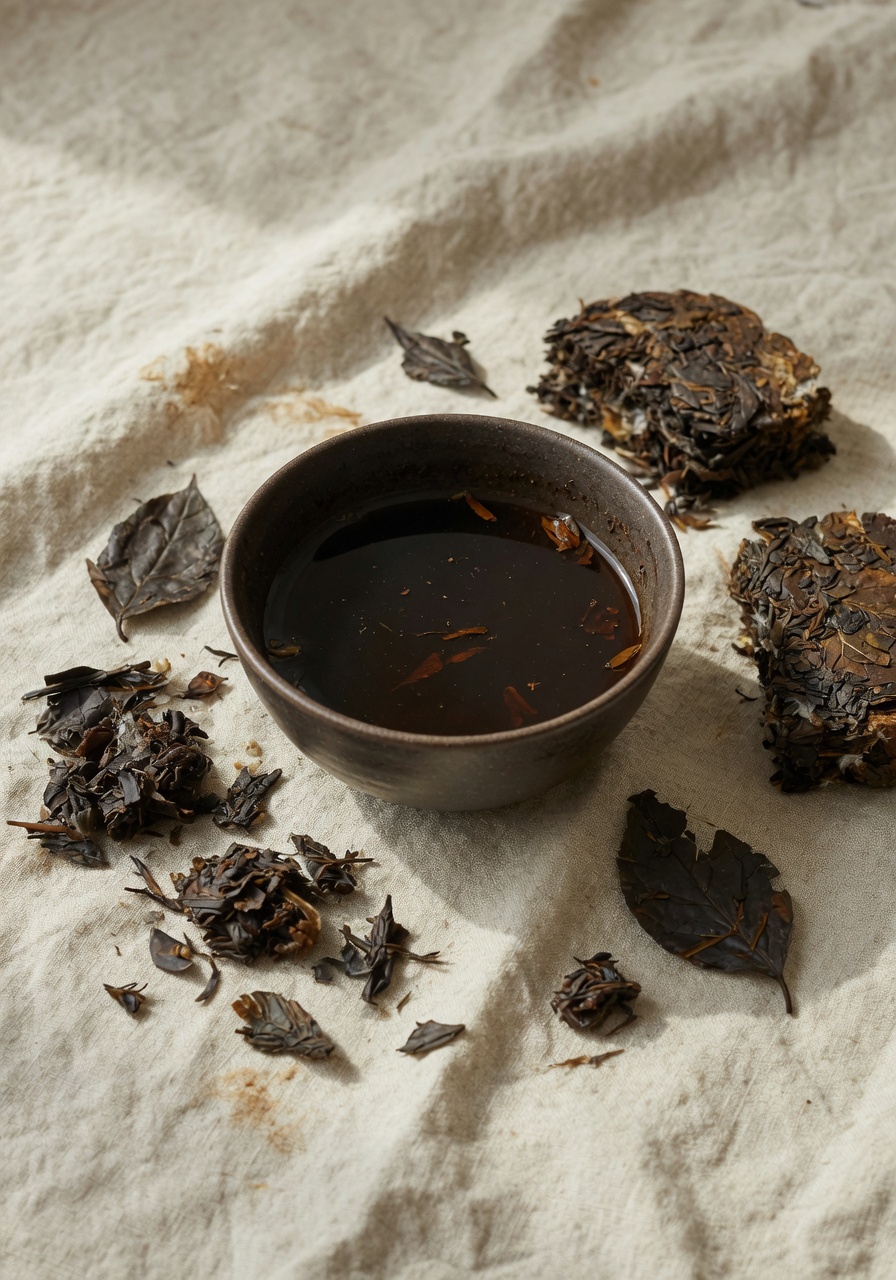
Theabrownins (chá hè sù, 茶褐素) sit at the end of a long oxidation chain. When fresh green tea is brewed, the dominant pigments are catechins — colourless in solution, astringent on the palate. Bruise the leaf, give it oxygen and microbial company, and those catechins polymerise: first into theaflavins (the bright orange of a good hóng chá), then into thearubigins (the deeper red of a mature black tea), and finally into theabrownins — high-molecular-weight, brown, and only marginally astringent. They are why a fifteen-year-old sheng cake from a Yiwu garden no longer tastes the way it did in 2010, and why a properly fermented shu cake from Menghai Tea Factory pours almost black from the gaiwan.
The modern interest in this pigment class is inseparable from the invention of wò duī (渥堆), the wet-pile fermentation process formalised at Kunming Tea Factory in 1973 and refined at Menghai through the late 1970s. Wò duī compresses decades of natural ageing into roughly forty-five days of controlled microbial activity — Aspergillus niger, Blastobotrys adeninivorans, and a shifting cast of yeasts work through the leaf pile at 55–65 °C. Theabrownin content in finished shu pu’er routinely measures 8–12% of dry weight, against under 2% in a fresh sheng. Aged sheng eventually catches up, but slowly: a 1998 Menghai sheng we tasted last year still showed lower theabrownin levels than a five-year-old shu from the same factory.
This is where the 2019 paper enters. A Kunming Medical University group, publishing in Nature Communications, reported that purified theabrownins from Pu’er tea lowered serum cholesterol in mice by altering bile acid metabolism through the gut microbiome. The mechanism was specific, the dose was high, and the species was murine — three caveats that mainstream coverage promptly dropped. Our companion piece, Aged sheng and serum lipids — a measured look at the 2019 paper, walks through the methodology slowly: what the controls were, what the effect size meant, and why a 300 mg/kg purified extract is not the same thing as a daily gaiwan of shú pǔ’ěr.
The microbiome angle deserves its own treatment, which we give it in Shu pu’er and the gut microbiome — small studies, big claims. The honest summary: human trials exist, most are small (n under 60), most are short (under twelve weeks), and the effect sizes for lipid markers cluster around modest. None of this makes theabrownins uninteresting. It makes them a research subject, not a prescription.
For drinkers, the practical question is whether the pigment chemistry that produces these molecules also produces a tea worth steeping. We think it does — but the case is made on the cup, not the chromatogram. The cross-archive on puerh.app covers the wò duī process and ageing taxonomy in production detail, and tea.school has a tasting module that walks through the visual and aromatic markers of theabrownin development. This page is the medical-adjacent companion: what the molecule is, what is claimed for it, and what the evidence will and will not support.
Nothing on tea.doctor is medical advice. Tea is a beverage with a long history and a growing research literature — both deserve patience.