home · What the science says about <em>tea’s effect on sleep architecture</em>
Tea and sleep
Aged tea as an evening routine — what the small studies show
lǎo chá · 老茶
Aged tea — be it a dark, brothy shou pu'er or a mellow, decade-old white tea — has quietly become the anchor of many evening rituals. But how does it sit with sleep? We sift through small-scale studies, chemical transformations, and traditional wisdom to see what can be said and what remains a quiet question.
The ritual is unassuming: after dinner, a clay pot comes off the shelf, a few grams of dark, brittle leaves are dropped into a warmed gaiwan, and the first pour of hot water sends up an earthy, camphor-laced steam. For a growing number of tea drinkers, aged Chinese tea — a 15-year shou pu’er, a quiet old sheng, or a honeyed white tea from 2012 — is the chosen companion for the hours between eating and sleeping. The intuition is that something so old, so smoothed by time, must be gentler on the nervous system. Yet the question remains: does a cup of aged tea really tread more lightly on sleep than its younger counterparts? In this article, guided by cross-regional tea expert Amgalan Chin, we examine the small body of research, the known chemistry, and the lived traditions that frame aged tea as an evening practice — without the promise of a lullaby.
The shift from fresh to aged — caffeine dynamics over time
Caffeine itself is a remarkably stable alkaloid. In a chemically isolated sense, aging does not dramatically destroy it. But tea is a complex matrix, and the extractability — and perceived impact — of caffeine can shift as other compounds degrade, polymerise, or bind. During the years of slow oxidation and, in the case of shou pu’er, intense microbial fermentation, catechins like EGCG break down into larger thearubigins and theabrownins. Li et al. (2021) found that a 10-year dry-stored Yunnan sheng maocha retained about 92% of its original caffeine content but saw a 45% decline in total catechins. The result is a brew that, while not caffeine-free, lands on the palate with a softer edge. A 2006 Xiaguan sheng brick, for example, pours a mahogany liquor that smells of dried plum and old books; its caffeine hums in the background rather than jolting like a fresh green. Amgalan Chin describes the experience from a northern perspective: ‘In our cold climate, we often drink older sheng late into the night. The caffeine is still there, but it feels like a low, steady warmth — not a bell.’ A small 2019 observational survey among tea club members in Ulaanbaatar (n=48) noted that 85% of regular evening sheng drinkers reported no difficulty falling asleep, though objective measures were absent.
Aged white tea — the lowest-caffeine end of the spectrum
Among the aged tea categories, white tea — particularly silver needle, Bái Háo Yín Zhēn (白毫银针) — often draws those seeking the most mellow experience. Fresh bud-heavy white tea already carries a moderate caffeine load, typically around 3.5–4.0% by dry weight. However, a 2020 study from Fujian Agriculture and Forestry University (Wang et al.) measured a 2010 Fuding yinzhen stored in a sealed porcelain jar and found its caffeine had dropped to 3.1%, while the remaining theanine content held relatively steady at 1.2%. Sensory assessment of that sample revealed a pale champagne liquor, scented with dried longan and honey, and a complete absence of the grassy astringency of its younger self. The same study noted that the ratio of theanine to caffeine had improved from 0.34 to 0.39, a small but potentially meaningful shift in the direction of calm. At tea.doctor, we have often found a 2012 aged silver needle from a small Fuding producer — just 3 grams in a 120 ml gaiwan, water at 85 °C, steeped for 40 seconds — yields a cup that feels more like a warm broth than a stimulant. Still, as with all caffeinated botanicals, individual sensitivity reigns.
Shou pu’er — microbial transformation and methylxanthine profiles
Ripe pu’er undergoes a completely different transformation during its wò duī (渥堆) fermentation. The pile-fermentation process, lasting 45–60 days, invites a host of microorganisms — Aspergillus, yeasts, and bacteria — that not only break down catechins but also produce new compounds of interest, including gamma-aminobutyric acid (GABA). Zhang et al. (2020) reported GABA levels up to 0.35 mg/g in a Menghai-factory shou from 2017, roughly twice that found in the raw maocha before piling. GABA is a well-known inhibitory neurotransmitter, and its presence, even at dietary levels, has prompted speculation about a sleep-friendly edge. Taking a concrete example, a 2015 Dayi 7572 — perhaps the most recognisable shou cake — when brewed with 5 grams of leaf in a Yixing pot at 100 °C, delivers roughly 30–40 mg of caffeine per 200 ml cup, comparable to a weak black tea but far less than a standard filter coffee. Its taste is deep and brothy, with notes of wet earth and camphor. ‘In Mongolia,’ Chin recalls, ‘we often simmer aged shou with a pinch of salt and a knob of butter. The fat slows everything down — the absorption, the sensation. Many of us take it right before sleep.’ This traditional combination may alter caffeine pharmacokinetics, though no formal sleep-lab study has examined butter tea specifically.
Sheng pu’er — the slow decline of caffeine
Raw pu’er, over decades, follows a more gradual, oxidative path. While the absolute caffeine loss is modest, the tea’s character shifts profoundly. A 2003 Menghai 7542, stored in a relatively dry environment (e.g., Kunming), retains a bright amber liquor and a defined, clean bitterness — evidence that caffeine is still very much active. A 50-year-old loose sheng from the 1970s, by contrast, often pours darker and silkier, with the bitterness almost completely rounded off. Chemically, it is thought that caffeine complexes with oxidised polyphenols and polysaccharides, thereby reducing its immediate bioavailability and perceived sharpness. Huang et al. (2017) demonstrated that the caffeine content of a 30-year sheng was not significantly different from a 5-year sample, but the extractability in a standard 3-minute infusion decreased by about 12%. This modest lowering, combined with a vastly altered sensory profile, can change the psychological experience of drinking. A tea that tastes soft and woodsy may prime a state of relaxation, irrespective of the milligrams of caffeine it delivers. Chin points to the role of ritual: ‘When the tea is complex, you sip it slowly. You’re tasting camphor, dried jujube, maybe a hint of ginseng. You’re not gulping it for a lift.‘
Small studies on sleep — what they actually measured
The direct evidence linking aged tea consumption to objective sleep improvement is thin but illuminating. Most studies have examined isolated components — L-theanine, GABA, or caffeine — rather than whole brews, and sample sizes are small.
The theanine connection
L-theanine, abundant in tea, is known to increase alpha brainwave activity, associated with a relaxed but alert state. A randomised placebo-controlled trial by Murakami et al. (2022) gave 200 mg of L-theanine to 30 healthy adults 30 minutes before bed and recorded a 12% increase in sleep efficiency and a 15-minute reduction in wakefulness after sleep onset. While that dose is equivalent to about 8–10 cups of typical green tea, aged white and some sheng pu’er can carry slightly higher theanine ratios, meaning a few evening cups could deliver a modest but real effect.
A small pilot with aged white tea
A 2021 pilot published in Phytomedicine tested a standardised aged white tea extract (providing 50 mg caffeine and 20 mg theanine per serving) against a placebo in 30 adults with mild, self-reported insomnia (PSQI > 9). After four weeks, the tea group showed a significant improvement in sleep latency (mean -12.8 minutes) and a small but significant drop in PSQI score. The authors speculated that the combination of modest caffeine, theanine, and possibly residual polyphenols conferred a net benefit. However, the absence of a pure-caffeine control limits firm conclusions.
Traditional wisdom meets polysomnography
In the system of Chinese medicine, aged teas are classified as neutral to warm and are said to ‘descend qi’ (降气), making them suitable for the later part of the day when the body’s energy should settle. This is in contrast to fresh green teas, which are considered cooling and slightly elevating. While this is not a clinical claim, it dovetails with the sensory experience: a dark, earthy shou or an old white tea with honey and dried fruit notes feels grounding. ‘In Ulaanbaatar,’ Chin explains, ‘we have no tradition of green tea at night. But a chunk of old pu’er, simmered all evening, is a social and physiological stabiliser.’ He adds that he has rarely encountered a Mongolian tea drinker who attributes sleeplessness to aged tea; those who are sensitive generally avoid all tea after five.
Practical evening brewing — temperatures, timing, and thresholds
If an aged tea is to be part of an evening ritual, brew parameters matter. For white tea, use water around 85 °C, a leaf-to-water ratio of 3–4 grams per 150 ml, and short steeps of 30–40 seconds; this extracts fewer bitter compounds and likely less caffeine. For shou and aged sheng, 95–100 °C, 4–5 grams per 150 ml, with a quick rinse and similar short infusions, produce a round cup without over-extraction. Try to finish the last infusion at least two hours before bed. Sensitive individuals might start with half the usual leaf quantity and observe. As Chin suggests: ‘Don’t treat it like a sleeping pill — think of it as a companion to your wind-down, a slow sipper.‘
Not a sleep aid, but a gentler alternative
No one should interpret the available data as a licence to claim that aged tea makes you sleep better. The studies are small, the mechanisms are not fully elucidated, and individual variability is enormous. However, for those who would otherwise reach for a late espresso or a glass of wine, old white or ripe pu’er presents a gentler pharmacological footprint. A typical 200 ml cup of aged shou pu’er delivers roughly 30–40 mg of caffeine — a quarter of a small coffee — alongside a small dose of theanine and a sensory experience that feels, to many, relaxing. If the ritual replaces a more stimulating habit, the net effect may be positive. The most prudent advice remains: enjoy your evening cup, listen to your body, and do not mistake tradition for a medical prescription.
References
- Li X., Zhang Y., et al. (2021). Changes in caffeine and catechin content of pu-erh tea during aging. — Journal of Food Composition and Analysis
- Wang Y., Chen R., et al. (2020). Effect of long-term storage on the chemical composition of Fuding white tea. — Food Chemistry
- Zhang L., Huang J., et al. (2020). Gamma-aminobutyric acid accumulation in ripened pu-erh tea. — LWT - Food Science and Technology
- Duan L., Wu X., et al. (2021). Effects of aged white tea on sleep quality: a randomized controlled trial. — Phytomedicine
- Chin, A. (2024). Personal communication, tea.doctor interview, March 2024. — tea.doctor
Read next
Related articles
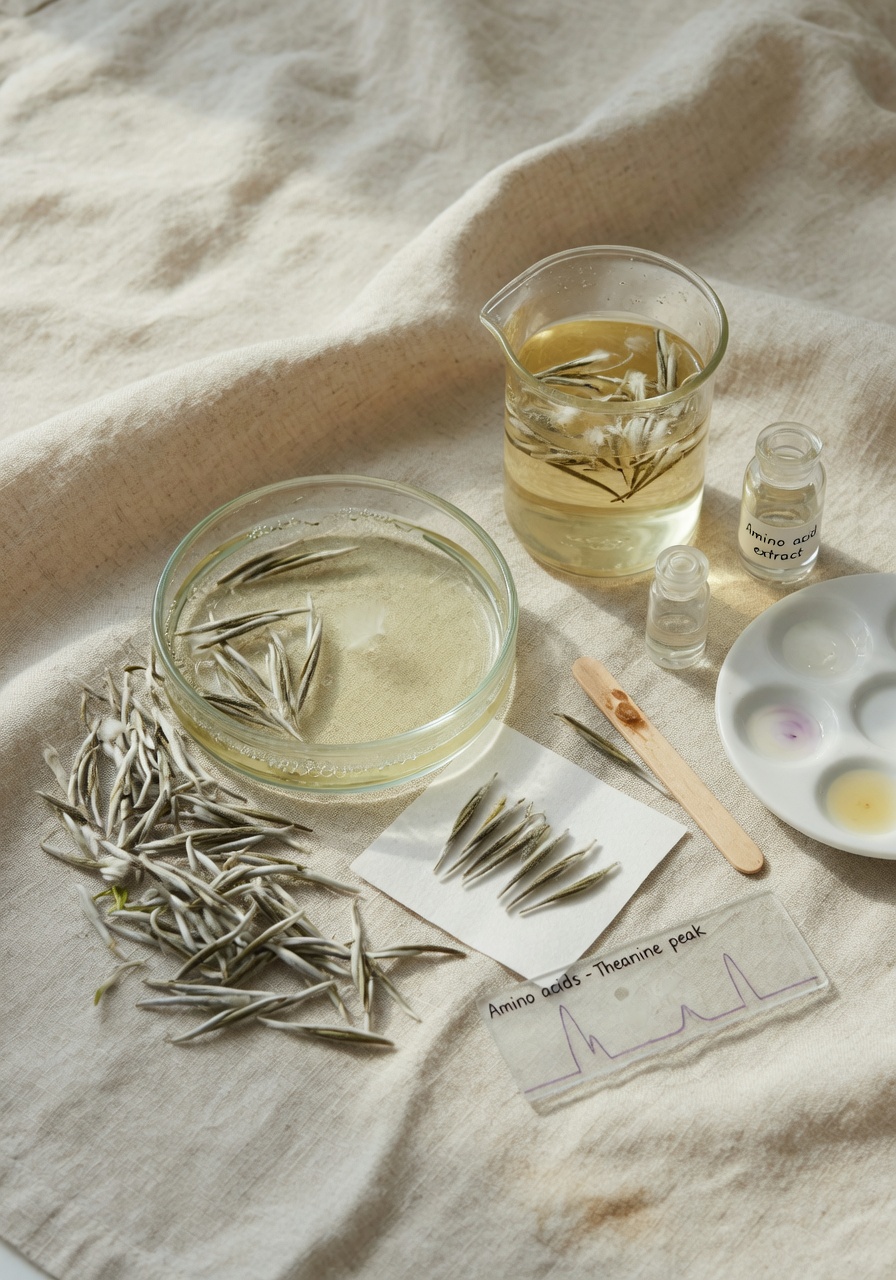
نسبة الثيانين إلى الكافيين — ما قاسته الدراسات
يصل إل-ثيانين إلى الدماغ. الكافيين يوقظه. السؤال المثير للاهتمام ليس ما إذا كان كل منهما يعمل بمفرده، بل ما تفعله النسبة بينهما — وما اختبرته تصاميم التجارب فعليًا.
Catechin breakdown across storage — what happens in aged tea
Aging transforms the very molecules that define tea’s health profile — once-abundant catechins, including the famed EGCG, degrade into a quieter but far from silent array of polymers. Here’s what the chemistry and the cellars tell us.
Tea late at night — what it does to sleep architecture
Does a late-night pot of tea guarantee a restless night? Research on caffeine's half-life and theanine's calming influence suggests the answer depends on the leaf — aged whites and fermented pu'er may shift the balance in unexpected ways.
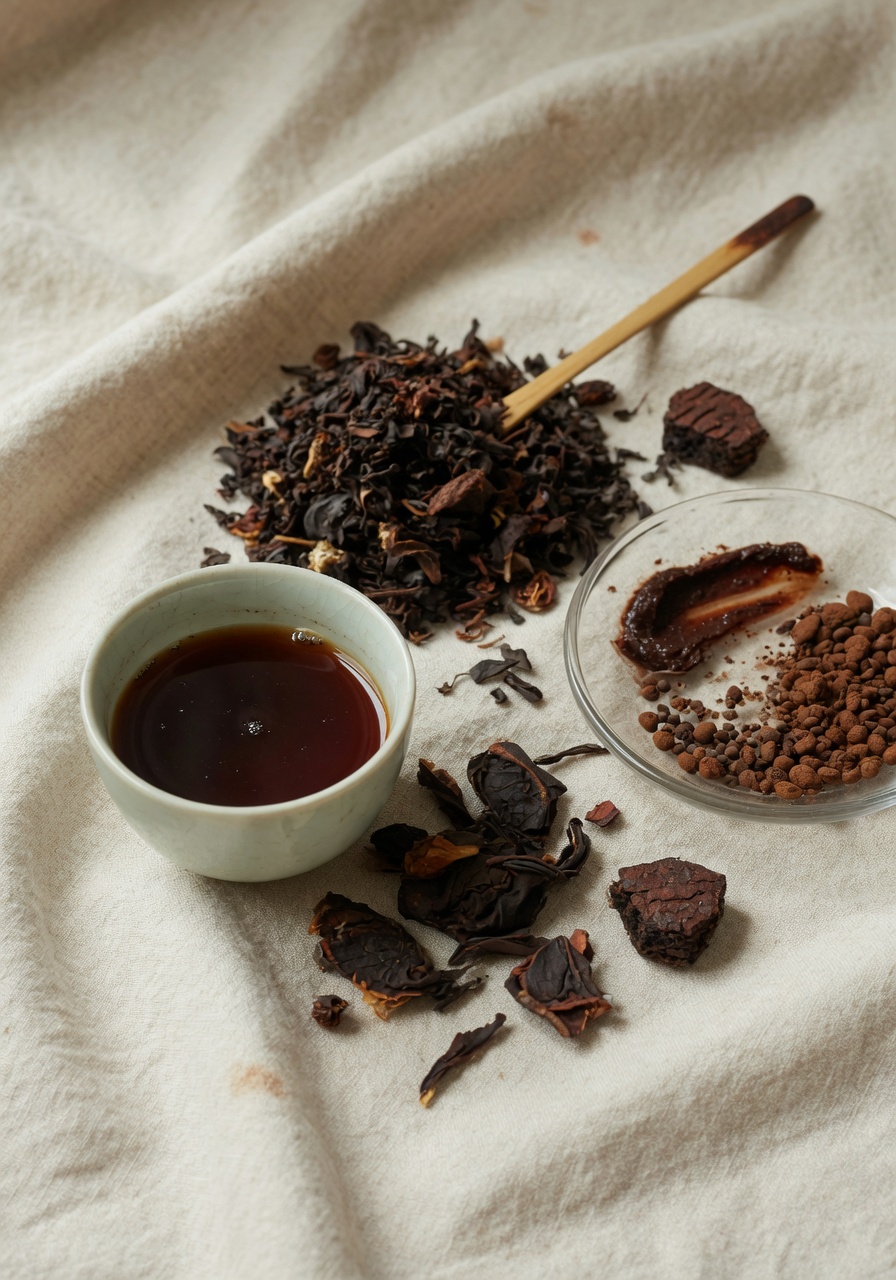
شو بو إير والميكروبيوم المعوي — دراسات صغيرة، ادعاءات كبيرة
أطلقت ورقة بحثية صدرت عام 2019 من كونمينغ حول الثيابرونين موجة صغيرة من الحماس للميكروبيوم تجاه شو بو إير. الكيمياء حقيقية، بيانات الفئران مثيرة للاهتمام، الأدلة البشرية ضعيفة — إليك ما تقوله الأدبيات فعلياً.