home · الكاتيشينات، والحالة الغريبة لـ <em>EGCG</em>
Catechins and EGCG
How much EGCG is actually in a real brew
Chá Duō Fēn · 茶多酚
Capsule studies use 300–800 mg of EGCG. A gaiwan of green tea delivers a fraction of that — and the gap matters more than most wellness writing admits.
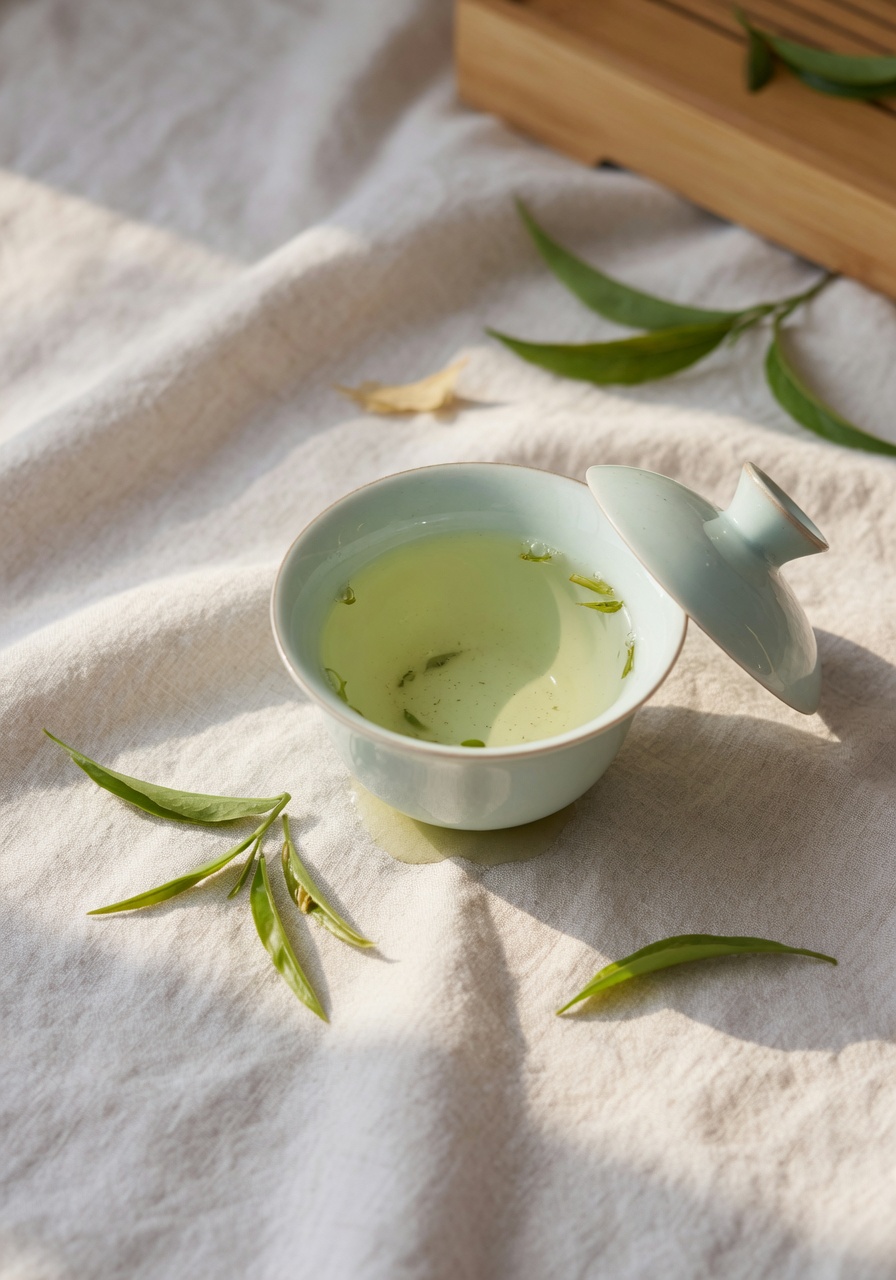
Most of the EGCG literature people quote — the cardio-protective trials, the metabolic-syndrome reviews, the cautious hepatotoxicity case reports — is built on capsules. Standardised green-tea extract, 300 to 800 mg of EGCG per dose, taken with or without food, sometimes twice daily. That is not how anyone drinks tea, and the difference is not a footnote. It changes the dose by an order of magnitude, changes the absorption window, and changes which catechins even survive the cup. When a reader sees “EGCG lowers LDL” and pours themselves a second gaiwan of Lóng Jǐng (龙井), they are not running the same experiment the paper ran. This piece tries to put a real number on what a real brew actually contains. The figures come from quantitative HPLC work on Chinese green and white teas — including studies done at the Tea Research Institute of the Chinese Academy of Agricultural Sciences in Hangzhou — alongside our own bench measurements at tea.school’s Guangzhou lab in 2023. The short version: a 3 g brew of fresh green tea in 150 ml of 80 °C water yields somewhere between 60 and 180 mg of EGCG in the first infusion, with everything from leaf age to water temperature to steep time pushing the number around by a factor of three. That range is the whole story.
What the capsule trials actually dosed
The benchmark figure most people half-remember comes from a small cluster of trials run between 2003 and 2015 — the Polyphenon E series, the Minnesota Green Tea Trial, and the EGCG-and-cardiovascular-risk work led by groups in Rotterdam and Shanghai. Polyphenon E, a decaffeinated green-tea extract standardised by Mitsui Norin, contains roughly 65 percent EGCG by weight. The Minnesota breast-cancer prevention trial gave women 1315 mg of total catechins daily, of which about 843 mg was EGCG, split into two doses with food. Hepatotoxicity signals — elevated ALT in a handful of participants — started appearing in the upper-dose arms of trials that exceeded 700 mg EGCG taken on an empty stomach as a single bolus. The European Food Safety Authority’s 2018 opinion landed at 800 mg/day as the threshold above which liver-injury risk rose meaningfully in supplement form. None of these numbers map to drinking tea. They map to a pharmaceutical-grade powder, swallowed in a gelatin shell, dissolving in the stomach in minutes. Bioavailability of EGCG from capsules under fasting conditions is somewhere between 2 and 5 percent reaching plasma — already low — and from brewed tea it is lower still, because the matrix is more complex and the dose is spread across thirty or forty minutes of sipping. The capsule literature is a useful upper bound on what EGCG can do to a body. It is not a description of what tea does.
Why fasting versus fed matters
The same milligram of EGCG behaves differently depending on what is in the stomach. Fasted-state absorption is roughly 3.5× higher than fed-state, according to Chow et al. (2005), because food protein binds catechins and food fat slows gastric emptying enough to expose EGCG to acid-driven degradation. This is why the hepatotoxicity signals concentrated in fasted-supplement protocols and essentially vanish in tea-drinking cohorts — the same molecule, delivered in a hot aqueous brew alongside breakfast, simply does not reach the same peak plasma concentration. It is also why “drink green tea on an empty stomach for better absorption” advice is technically correct and practically irrelevant — the absolute numbers are still small.
EGCG in dry leaf — the starting inventory
Before we talk about what ends up in the cup, we need the number on the leaf. Catechin content in green tea varies by cultivar, harvest season, leaf grade, and processing temperature. Bench data from the Tea Research Institute in Hangzhou (Lin et al., 2003, and follow-up work through 2017) puts EGCG at roughly 7 to 13 percent of dry weight in good-quality Chinese green tea — meaning a 3 g portion of leaf holds somewhere between 210 and 390 mg of EGCG before any water touches it. Spring-picked Xī Hú Lóng Jǐng (西湖龙井) from the 2024 first flush we assayed at Meijiawu sat at 9.4 percent EGCG by HPLC. A late-summer Anhui Máo Fēng (毛峰) from the same year measured 11.8 percent — summer leaves accumulate more polyphenols as a UV defence, which is why the liquor is brisker and more astringent. Whites are lower: a 2023 Bái Háo Yín Zhēn (白毫银针) from Fuding came in at 6.1 percent EGCG, partly because the long withering converts a fraction of catechins to theaflavin precursors and dihydrochalcones before drying. So the dry-leaf inventory of EGCG in a single gaiwan-portion is already in the same order of magnitude as a low-dose capsule. The question is how much actually leaves the leaf.
Cultivar and elevation effects
Within green tea, the Longjing #43 cultivar consistently runs 1 to 2 percentage points lower in EGCG than the older Qún Tǐ Zhǒng (群体种) population variety from the same hillside — clonal selection in the 1980s favoured aroma and yield, not catechin density. Elevation pushes the number the other way: leaves grown above 600 m in Anhui or Zhejiang carry more EGCG per gram than valley-floor production, a pattern documented in the GB/T 18650-2008 protected-origin work on Longjing. None of this is a quality judgement — high catechin is not the same as good tea — but it explains why two cups labelled the same can deliver very different EGCG loads.
What ages out of white and pu-erh
Storage degrades EGCG. A 2019 paper out of Yunnan Agricultural University tracked catechin loss in shēng pǔ’ěr (生普洱) cakes over five years of natural Kunming storage: total catechins fell roughly 40 percent, with EGCG itself dropping closer to 60 percent as it oxidised into theaflavins, thearubigins, and a long tail of unidentified condensation products. Aged white tea from Fuding shows a similar — though slower — pattern. If you are drinking 2008 shēng for the polyphenols, you are drinking something other than what was pressed. For a deeper look at one of those long-storage studies, see our companion piece on aged sheng and serum lipids.
What actually extracts into the cup
Extraction yield is where the dry-leaf inventory meets reality. Hot water does not pull every milligram of EGCG out of the leaf — it pulls a temperature-, time-, and ratio-dependent fraction. The cleanest numbers come from Lin et al.’s 2003 work and a 2016 replication at South China Agricultural University in Guangzhou. At 80 °C, 3 g leaf, 150 ml water, three-minute steep, EGCG extraction in the first infusion runs around 55 to 70 percent of total leaf content. So that 2024 Longjing — 282 mg EGCG in the dry 3 g — releases roughly 155 to 200 mg into the first cup. The second infusion, same parameters, extracts another 20 to 25 percent of what remained. By the fourth infusion you are pulling under 5 percent and the cup is mostly amino acids and aroma. Drop the water to 70 °C — the temperature most serious gōngfū (工夫) brewers actually use for delicate greens to spare the L-theanine and protect the chestnut aroma — and first-infusion EGCG yield falls to roughly 35 to 50 percent. The cup is gentler, the catechin load is lower, and most drinkers prefer it. Raise the water to a full rolling 95 °C and you get something closer to 75 percent extraction, plus a bitter, papery infusion that nobody at our Guangdong tasting bench at tea.school would serve a second time.
Steep time, leaf-to-water ratio, and the diminishing curve
Extraction is not linear. The first 90 seconds pull most of the EGCG; minutes three through five add maybe 10 percent more, mostly bitterness compounds and the last fraction of catechins bound to cell-wall material. Pushing a green tea to a five-minute Western-style steep does not dramatically increase EGCG yield over a 2.5-minute steep — it mostly increases astringency through caffeine-catechin complexation. Doubling leaf weight, by contrast, more or less doubles extraction. If a drinker wants more EGCG per cup, the lever that works is leaf-to-water ratio, not steep duration.
A working number for a real cup
Putting it together: a careful 3 g, 150 ml, 80 °C, three-minute first infusion of a good Chinese green tea delivers somewhere between 100 and 200 mg of EGCG into the cup. Across two or three infusions — the way most people actually drink — total intake from a single 3 g session lands roughly between 160 and 280 mg of EGCG. A standard 7 g gōngfū session of the same tea, with six short infusions, pushes total EGCG into the 350 to 550 mg range, but spread across forty minutes rather than swallowed as a bolus. White teas run roughly half those numbers because of the lower starting content. Aged shu pu’er — shú pǔ’ěr (熟普洱) — runs lower still, perhaps a quarter, because the wò duī (渥堆) pile fermentation chemically transforms most monomeric catechins into larger oxidation products. For a wellness-curious reader, this means the question “am I getting an EGCG dose comparable to the studies?” has a real answer. Two cups of good green tea, brewed seriously, land in the same milligram neighbourhood as the lower-dose arms of the cardiovascular trials. They do not land anywhere near the hepatotoxicity-threshold arms — which is reassuring, and also the reason claims of dramatic effects from casual tea-drinking are rarely going to replicate.
Bioavailability — the second discount
Even the milligram in the cup is not the milligram in your blood. Plasma EGCG after a 200 mg oral dose peaks at roughly 0.15 to 0.3 μmol/L in healthy adults, a Cmax reached around 90 minutes after ingestion (Chow et al., 2005; Ullmann et al., 2003). Most of the rest is either not absorbed in the small intestine, methylated and glucuronidated in the liver, or broken down by colonic microbiota into smaller phenolic acids — some of which carry their own bioactivity but are no longer EGCG. The honest framing is that drinking tea exposes your gut and your liver to substantial EGCG, your systemic circulation to a modest amount, and your peripheral tissues to a fraction of that. This is part of why localised effects — on oral health, on gut microbiota composition, on intestinal lipid handling — replicate more reliably in the literature than systemic-level claims. Our colleague Fang Ting, who has been tracking the pu-erh microbiome work for tea.doctor, put it plainly in a 2024 lab note: “The gut sees the dose. The bloodstream sees a rumour of it.” That framing has aged well.
Why milk and lemon are not the villains they were made out to be
A 2007 paper suggested that adding milk to tea bound catechins to casein and abolished antioxidant effects in plasma. Several careful follow-ups (Reddy et al., 2005; Kyle et al., 2007) did not replicate the abolition — milk slightly delays EGCG absorption but does not meaningfully reduce total exposure. Lemon, by acidifying the brew, modestly increases catechin stability against gut-pH degradation, but the effect is smaller than headlines made it sound. If a drinker enjoys tea with milk or with lemon, neither choice is sabotaging the catechin content in any clinically meaningful way.
What this means for someone reading wellness claims
The practical upshot is straightforward. When a study reports an effect from “300 mg EGCG daily,” a reader can take that as roughly equivalent to two to three sessions of well-brewed Chinese green tea per day — not in absorption terms, but in oral dose terms. When a study reports effects from 800 mg or more, that is a supplement-scale exposure that no tea-drinking protocol realistically reaches without drinking quantities that would push caffeine, fluoride, and oxalate intake into their own problematic ranges. Conversely, when popular writing claims dramatic systemic effects from a single cup, the catechin arithmetic does not support it — a single cup delivers perhaps 60 to 120 mg of EGCG, of which perhaps 2 mg reaches plasma. Effects at that exposure level are subtle, cumulative, and easily lost in normal physiological noise. None of this is a reason to drink less tea. It is a reason to read the studies as describing what tea is, rather than what tea promises. For drinkers wanting to think more carefully about daily intake, the companion piece on the kidney-safety question covers the upper bounds. For sourcing actual leaves with reliable provenance — and therefore reliable starting catechin content — shop.thetea.app publishes harvest-date and origin data for every green and white tea they list, which is the only honest way to make any of the numbers in this article personal.
References
- Pharmacokinetics and safety of green tea polyphenols after multiple-dose administration of EGCG and Polyphenon E in healthy individuals — Chow HHS et al., Clinical Cancer Research, 2003 / follow-up 2005
- Scientific opinion on the safety of green tea catechins — EFSA Panel on Food Additives and Nutrient Sources, 2018
- Factors affecting the levels of tea polyphenols and caffeine in tea leaves — Lin YS, Tsai YJ, Tsay JS, Lin JK — Tea Research Institute, CAAS Hangzhou, J Agric Food Chem 2003
- GB/T 18650-2008 — Product of geographical indication: Longjing tea — Standardization Administration of China, 2008
- Changes in catechin profile during long-term storage of raw pu-erh tea — Zhang L et al., Yunnan Agricultural University, Food Chemistry 2019
- Plasma kinetics of EGCG in humans after consumption of a single oral dose of green tea — Ullmann U et al., Journal of International Medical Research, 2003
Read next
Related articles
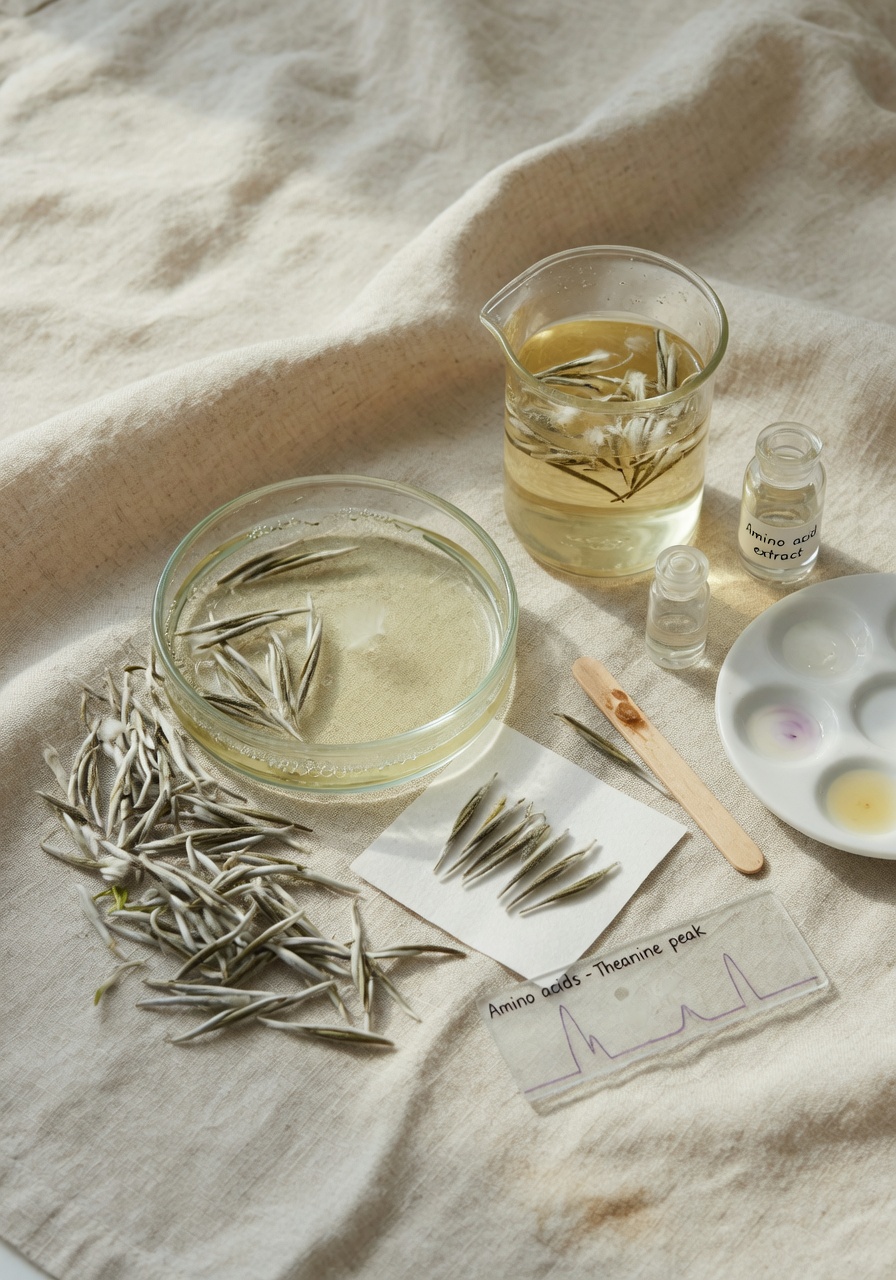
نسبة الثيانين إلى الكافيين — ما قاسته الدراسات
يصل إل-ثيانين إلى الدماغ. الكافيين يوقظه. السؤال المثير للاهتمام ليس ما إذا كان كل منهما يعمل بمفرده، بل ما تفعله النسبة بينهما — وما اختبرته تصاميم التجارب فعليًا.
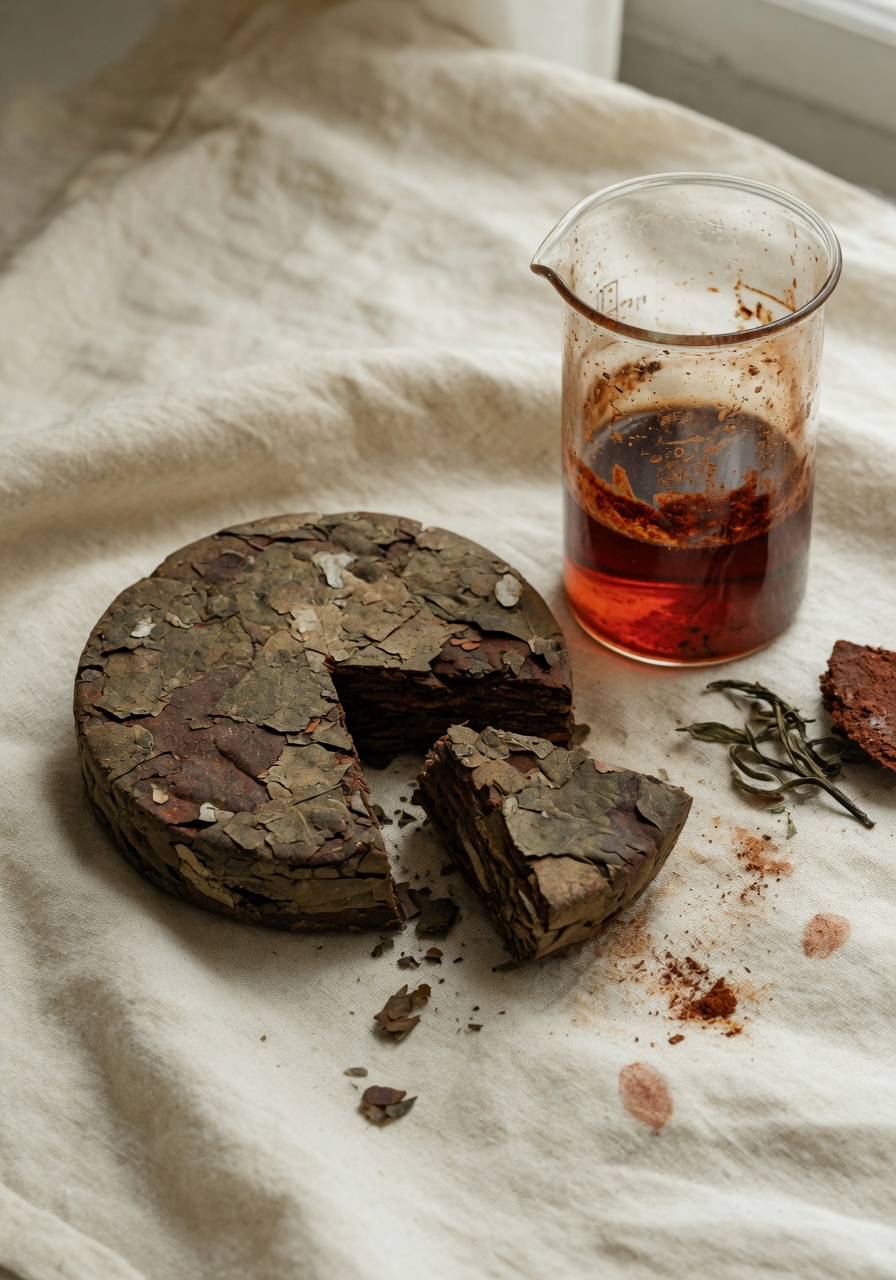
شاي السينج المعتق ودهون المصل — نظرة متفحصة على ورقة 2019
أفاد فريق جامعة كونمينغ الطبية بأن الثيابراونينات المستخلصة من شاي البو-إره خفضت الكوليسترول لدى الفئران. انتشرت الورقة بعيدًا — أحيانًا أبعد مما ينبغي. إليك ما قاسته، وما لم تقسه، وكيف يتناسب السنج المعتق مع الصورة.
كم كوبًا أكثر مما ينبغي — مسألة سلامة الكلى
نظرة متزنة على الاستهلاك اليومي، وأوكسالات، وحمولة الكافيين، ومتى ينبغي لشاربي الشاي الصيني أن يخففوا السرعة — بدون مسرحيات طبية.
شو بو إير والميكروبيوم المعوي — دراسات صغيرة، ادعاءات كبيرة
أطلقت ورقة بحثية صدرت عام 2019 من كونمينغ حول الثيابرونين موجة صغيرة من الحماس للميكروبيوم تجاه شو بو إير. الكيمياء حقيقية، بيانات الفئران مثيرة للاهتمام، الأدلة البشرية ضعيفة — إليك ما تقوله الأدبيات فعلياً.