home · author
The team
Amgalan Chin
Cross-Regional Tea Expert & Technical Specialist
Russia–Mongolia
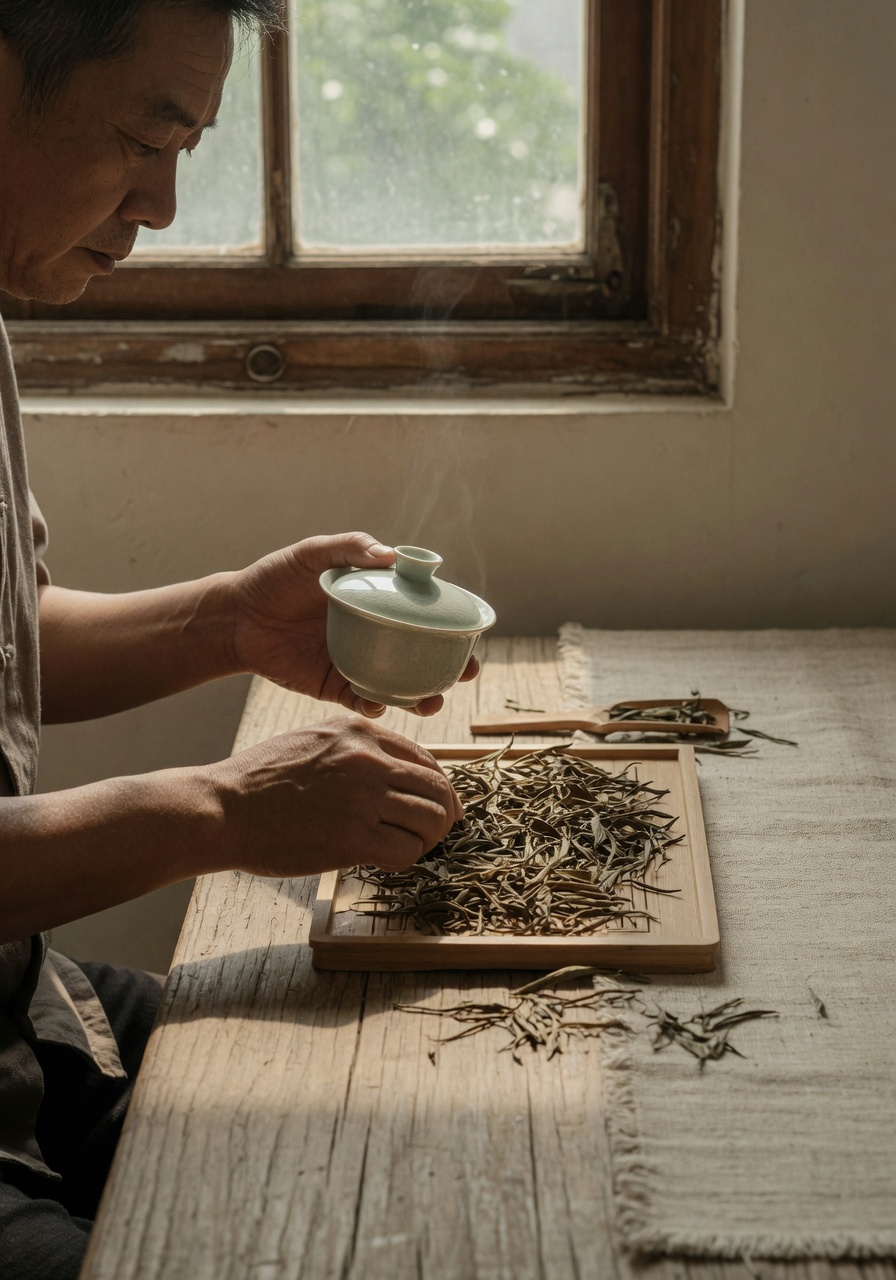
Amgalan Chin was born in Kyakhta, the old border town on the Russian–Mongolian frontier where caravan tea once paid for sable furs and silver rubles. His grandmother kept compressed bricks of Hunan dark tea in a cedar trunk and brewed them with milk and a pinch of salt — a habit Amgalan still defends when colleagues from Guangzhou raise an eyebrow. That childhood, spent between Buryat steppe and the customs ledgers of the Great Tea Road, set the frame for everything that followed: tea as cargo, tea as medicine, tea as a thing that survives long winters.
He began formal study in 2004 under Zhou Hongjie at the Yunnan Agricultural University extension in Menghai, focusing on post-fermentation chemistry of shú pǔ'ěr (熟普洱). From 2007 to 2013 he lived on and off in Bulang Shan, apprenticing with the Su family in Lao Banzhang and the Zhang cooperative in Mansai — relationships that still supply the spring maocha he ages today. A second mentorship, with Yiwu producer Gao Faqing, taught him the slower hand needed for shēng (生) destined to sit twenty years. His 2014 monograph on humidity-controlled aging in continental climates — written in Russian and later translated for Chá Yè Kē Xué — argued that Moscow and Ulan-Ude cellars produce a distinct aromatic profile from Kunming dry-storage, with measurably lower theabrownin formation and a longer camphor phase.
Amgalan's working cellar sits outside Irkutsk: 340 square metres, 62–68 percent relative humidity, temperature swing of 8 to 19 °C across the year. He stores roughly 1.8 tonnes of shēng from the 2008–2019 harvests and a smaller library of Anhua fú zhuān (茯砖) and Liu Bao for comparative tasting sessions. Vendors on shop.puerh.app and shop.thetea.app source his aged cakes when supply allows; he caps annual release at around 80 kilograms because, as he puts it, slow tea cannot be hurried by a spreadsheet.
For tea.doctor he writes carefully, with the wariness of someone who has watched health claims attach themselves to pu-erh like burrs to wool. His piece "Aged sheng and serum lipids — a measured look at the 2019 paper" walks readers through the Kunming Medical University cohort study, separating what the data actually showed from what the marketing copy later claimed. In "Shu pu'er and the gut microbiome — small studies, big claims," he weighs the Aspergillus-driven fermentation literature against the modest sample sizes most published trials rely on. Both essays carry his standard disclaimer: traditional use is not a prescription, and a cup of tea is not a clinical intervention.
He teaches the pu-erh and dark-tea paths on tea.school, hosts the seasonal aging cohort on tea.community, and contributes the aging-section essays on puerh.app. Students learn to read a wrapper, to smell the difference between wet storage and humid storage, and to keep tasting notes in pencil because ink fades faster than tea does.
Amgalan speaks Russian, Mandarin, Buryat, and enough Yunnanese to argue about price. He drinks his morning cup from a zhū ní (朱泥) pot his teacher gave him in 2011, and he still salts the occasional bowl of brick tea when the weather drops below minus thirty.
Specialties
- sheng pu-erh
- shou pu-erh
- aging
- dark tea
- Russian–Mongolian trade routes
- Bulang/Yiwu