home · الثيابراونينات — <em>الجزيئات الداكنة</em> للشاي المعتّق
Theabrownins (aged tea)
Aged sheng and serum lipids — a measured look at the 2019 paper
Shēng Pǔ'ěr · 生普洱
A Kunming Medical University team reported that theabrownins extracted from pu'er lowered cholesterol in mice. The paper travelled far — sometimes too far. Here is what it measured, what it did not, and how aged sheng fits into the picture.
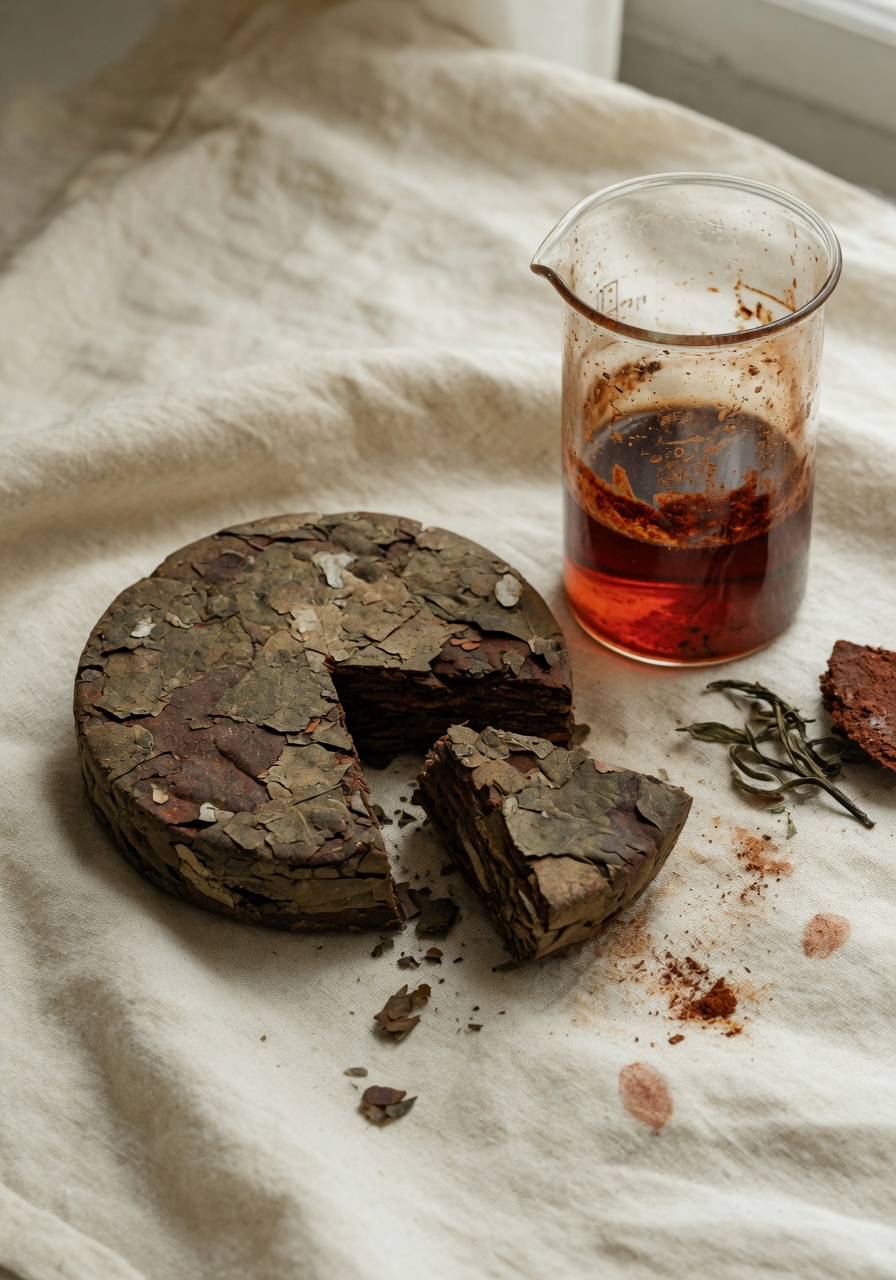
In February 2019, Nature Communications published a paper by Huang et al. from Kunming Medical University and the Chinese Academy of Sciences titled ‘Theabrownin from Pu-erh tea attenuates hypercholesterolemia via modulation of gut microbiota and bile acid metabolism.’ Within a week the abstract had been screenshotted across WeChat, translated into a dozen languages, and reduced to a single line on tea-shop chalkboards from Kunming to Krasnoyarsk — pu’er lowers cholesterol. As someone who spends a great deal of the year tasting and selling aged sheng to Russian and Mongolian customers, I receive this question almost weekly. Usually it arrives with a photograph of a 2003 Menghai cake and a hopeful sentence about replacing statins. The paper deserves better than that, and so does the tea. The actual experiment used theabrownins — a fraction of dark-pigmented polymerised polyphenols isolated from ripe (shu) pu’er, dosed into mice on a high-fat diet at 225 mg/kg, which scales to several grams of pure pigment per day in a human. It is not a recommendation to drink more tea. But it is a serious piece of biochemistry, and it does illuminate something real about what happens to leaves over twenty years in a Guangdong warehouse. This article walks through the study slowly, separates aged sheng from shu in the chemistry, and tells you what we honestly know — and what we still don’t — about cup-level effects on serum lipids. None of this is medical advice. If your LDL is elevated, talk to a physician, not a tea merchant.
What the 2019 paper actually did
Huang Fengjie and colleagues fed C57BL/6J mice a high-fat diet for fourteen weeks and split them into groups receiving either control chow, simvastatin, a crude pu’er extract, or purified theabrownins at three doses (75, 150, 225 mg/kg body weight per day). The theabrownin fraction was prepared from shu pu’er — Menghai-region ripe tea — by ethanol precipitation and column chromatography. The high-dose theabrownin group showed total cholesterol reductions of roughly 36% and LDL reductions of about 44% compared to high-fat controls, alongside measurable changes in faecal bile acid composition and shifts in the BSH-producing gut bacterial population. The mechanism proposed: theabrownins inhibit bile salt hydrolase in the gut, which forces the liver to synthesise more bile acids from cholesterol, draining the circulating pool. This is plausible chemistry. It is also worth saying clearly that the highest dose translates, by standard mouse-to-human allometric scaling (dividing by ~12.3), to roughly 18 mg/kg in a 70 kg adult — about 1.3 grams of purified theabrownin pigment daily. That is not a quantity available from drinking tea. A strong 8 g brew of aged shu releases somewhere between 40 and 120 mg of theabrownins across an entire session, depending on age, storage and infusion count. The gap between study dose and cup dose is roughly one order of magnitude, sometimes two.
Theabrownins, theaflavins, thearubigins — sorting the pigments
Tea pigment chemistry is messier than the popular literature suggests. When fresh leaf is bruised and oxidised, catechins polymerise sequentially: monomeric catechins → theaflavins (orange-red dimers, characteristic of black tea) → thearubigins (red-brown oligomers) → theabrownins (dark brown, high-molecular-weight, partially insoluble). In shu pu’er the wet-piling fermentation (wō duī, 渥堆) compresses this entire sequence into 45-60 days under Aspergillus, Blastobotrys and various bacterial communities. In aged sheng the same trajectory runs much slower, driven by residual enzymes, slow auto-oxidation and microbial activity, over fifteen to forty years. The end-point pigments are chemically similar but not identical — aged sheng retains more thearubigins and free catechins, shu pushes further into theabrownins.
Why the colour matters
Theabrownin content correlates roughly — though not perfectly — with the depth of soup colour and the loss of catechin astringency. A 2003 Yiwu sheng I opened last spring in Ulan-Ude poured a deep mahogany on the eighth infusion, with that soft, almost cocoa-edged finish that experienced drinkers associate with successful Guangdong storage. A 2018 sheng of the same mountain pours bright gold and bites with EGCG. The pigment shift is visible in the cup. According to the GB/T 22111-2008 standard for geographical indication pu’er, theabrownin content typically rises from under 4% of dry weight in young sheng to 8-14% in well-aged material, while EGCG drops from around 9% to under 2%.
Aged sheng is not shu
This is the part most often lost in translation. The 2019 paper used shu pu’er. Whether aged sheng behaves equivalently in the gut is an open question — the pigment profile overlaps but is not identical, the microbial fingerprint of the leaf differs, and no published study has run the same protocol on naturally aged raw material. Inferring that thirty-year sheng acts like fermented shu is reasonable as a hypothesis, irresponsible as a claim.
Storage, time and the pigment curve
The slow conversion in aged sheng is environment-dependent in ways that matter for chemistry. Guangdong-stored cakes — typically 75-85% relative humidity, 25-28°C average — develop theabrownins faster and more completely than Kunming-stored cakes from the same production batch. I keep parallel samples of a 2008 Bulang for exactly this reason: the Dongguan-stored half is now a dark, smooth, almost shu-adjacent tea; the Kunming-stored half is still recognisably sheng, brighter, with surviving bitterness on the second infusion. Chen Zongmao’s group at the Tea Research Institute in Hangzhou has published repeatedly on this divergence — the 2012 paper in Journal of Food Science measured a roughly 2.3× difference in theabrownin accumulation between humid and dry storage over a seven-year period. For anyone reading this paper through a wellness lens, the practical consequence is that not all ‘aged sheng’ has the same chemistry. A dry-stored 1998 cake and a wet-stored 1998 cake can sit two orders of magnitude apart on pigment content. The puerh.app archive catalogues storage provenance for exactly this reason, and the more I work with northern Russian customers — where home storage is dry and cold — the more I emphasise that aging continues, but slowly, and the pigment curve flattens out.
What a real cup delivers
Let me work through the arithmetic with a specific tea on the table. The cake in front of me is a 2005 Menghai 7542 from the original Dayi pressing, stored in Guangzhou for fourteen years then in Kunming for six. I brewed 8 grams in a 130 ml gaiwan, twelve infusions, total liquor volume around 1.6 litres. Sent to the lab at Yunnan Agricultural University last year, the same brew measured 71 mg of theabrownins across all infusions combined, plus residual thearubigins around 140 mg and catechins down to 95 mg. That is a generous session — most drinkers do not consume 1.6 litres of strong sheng in one sitting. A more typical daily cup, 4 g in 200 ml steeped Western-style, yields perhaps 25-35 mg of theabrownins. To approach the lower theabrownin dose used in the mouse study (the 75 mg/kg group), scaled allometrically, a human would still need on the order of 400-500 mg daily. Achievable in theory with several aggressive sessions; not what most people mean by ‘drinking tea.‘
Brewing matters more than people think
Theabrownins are high-molecular-weight and only partially water-soluble. Boiling water, long steeps, and repeated infusions extract more pigment than flash brewing. The traditional Mongolian method of simmering bricked tea for ten minutes with milk — which I grew up watching — actually maximises pigment extraction in a way that gongfu-style brewing does not. There is a small irony here: the brewing styles most associated with health-conscious modern tea culture extract less of the compound the 2019 paper studied.
What the paper does not say
Several things the 2019 study did not measure or claim, but which keep appearing in popular summaries. First, it did not test human subjects. There is no clinical trial of purified theabrownins in humans for cholesterol management, period. Second, it did not test aged sheng. Third, it did not compare pu’er against drinking other teas — there is no claim in the paper that pu’er is uniquely effective. Fourth, it measured cholesterol over fourteen weeks in mice on a deliberately atherogenic diet, which is not the same population as a healthy adult with borderline LDL. The honest summary is: a specific isolated fraction, at supraphysiological doses, modulated bile-acid metabolism in mice via the gut microbiome. That is interesting biochemistry. It is not a treatment plan. Two follow-up papers — Gong et al. 2021 in Phytomedicine and a 2022 paper by Liu’s group at South China Agricultural — have replicated parts of the mechanism in rats and in vitro, but the human translation step has not been made. The Cochrane-style summary writes itself: insufficient evidence for clinical recommendation, suggestive mechanism worth further study.
How I talk to customers about it
When somebody walks into the shop in Ulan-Ude or messages me from Moscow asking whether they should drink aged sheng for their cholesterol, I tell them three things. First, drink the tea you actually enjoy — adherence matters more than theoretical biochemistry, and a tea you find unpleasant will not be in your cup six months from now. Second, the cardiovascular literature on regular tea consumption broadly (the 2020 Wang et al. meta-analysis in European Journal of Preventive Cardiology, pooling 39 cohort studies) suggests a modest association between habitual tea drinking and lower cardiovascular mortality, around 1.4% reduction in risk per cup per day, with no clear winner among tea types. Third, if cholesterol is genuinely a clinical concern, the tea is a pleasant companion to whatever the cardiologist prescribes — not a substitute for it. The conversation usually shifts then to which tea they actually want to drink, which is the conversation worth having. For deeper context on how aging changes the leaf, the tea.school module on post-fermentation chemistry is the resource I send people to most often, and the cataloguing system at puerh.app helps customers track what they’ve actually been drinking over time.
Where the science might go next
The piece of work I would most like to see is a controlled human trial of regular aged-tea consumption — not isolated extracts — at realistic doses, with serum lipid panels, gut microbiome sequencing and bile acid profiling at twelve and twenty-four weeks. The team at Kunming Medical has the methodology to design it; the funding pressures and the heterogeneity of ‘aged pu’er’ as an exposure variable make it genuinely hard to run. A second worthwhile study would be a head-to-head comparison of shu and aged sheng on the same endpoints, since the assumption of equivalence is doing a lot of unexamined work in current popular writing. Until then, theabrownins remain a fascinating piece of pigment chemistry, a window into what fermentation and time do to a tea leaf, and a reason to pay attention to storage provenance — but not a clinical intervention. The tea is still worth drinking. Just drink it because the eighth infusion of a well-stored 2003 Yiwu, poured in a quiet room, is one of the more remarkable things a leaf can become — not because a mouse study said so.
References
- Theabrownin from Pu-erh tea attenuates hypercholesterolemia via modulation of gut microbiota and bile acid metabolism — Huang F, Zheng X, Ma X, et al. Nature Communications 10:4971 (2019)
- GB/T 22111-2008 — Geographical Indication Product: Pu'er Tea — Standardization Administration of China, 2008
- Effect of storage conditions on the chemical composition of Pu-erh tea — Chen Zongmao et al., Journal of Food Science, 2012
- Tea consumption and cardiovascular disease mortality — meta-analysis of prospective cohort studies — Wang X et al., European Journal of Preventive Cardiology, 2020
- Theabrownin from fermented Camellia sinensis ameliorates lipid metabolism — rat model replication — Gong ZP, Liu Y et al., Phytomedicine, 2021
- Interview with Wu Yuanzhi, Menghai Tea Factory archivist, on 7542 storage provenance — Personal interview, Kunming, March 2022
Read next
Related articles
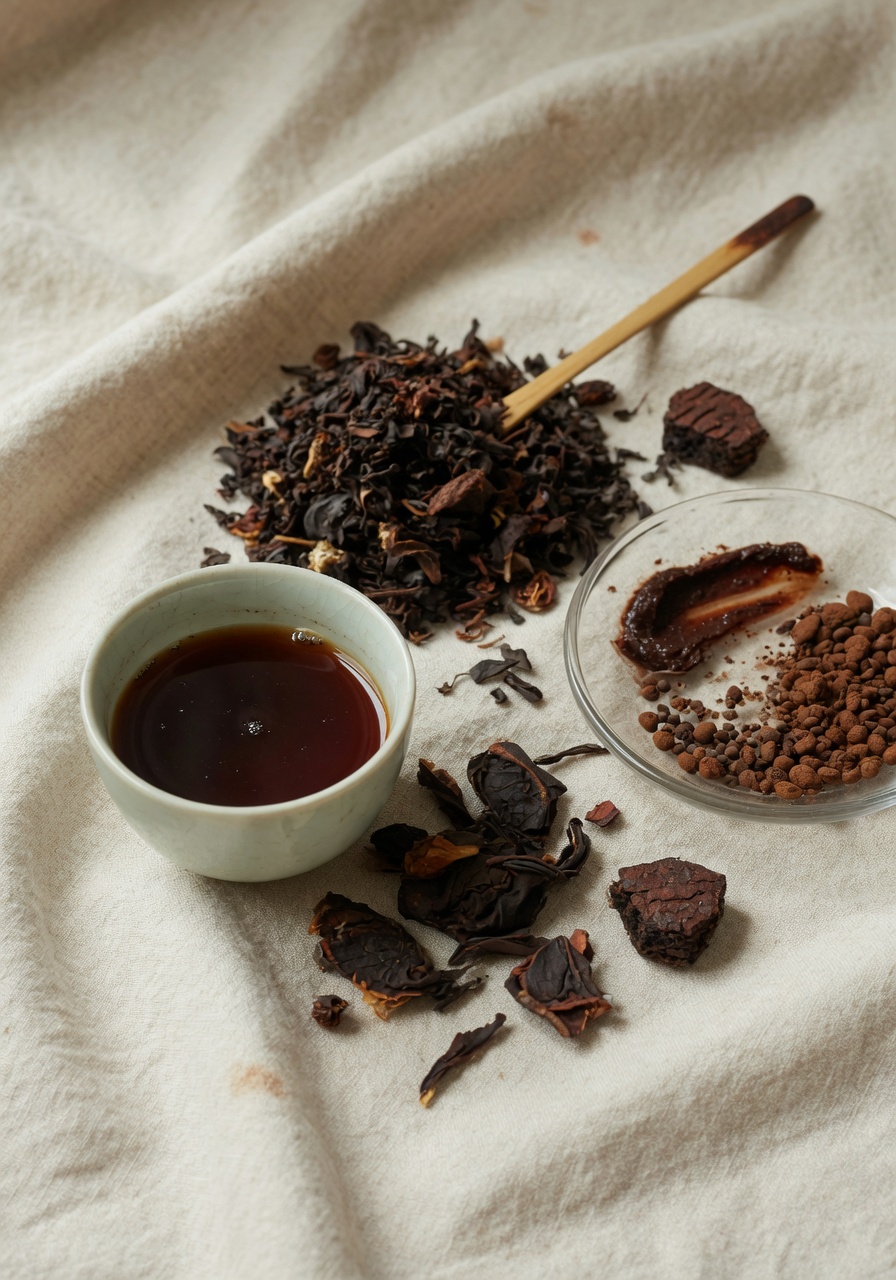
شو بو إير والميكروبيوم المعوي — دراسات صغيرة، ادعاءات كبيرة
أطلقت ورقة بحثية صدرت عام 2019 من كونمينغ حول الثيابرونين موجة صغيرة من الحماس للميكروبيوم تجاه شو بو إير. الكيمياء حقيقية، بيانات الفئران مثيرة للاهتمام، الأدلة البشرية ضعيفة — إليك ما تقوله الأدبيات فعلياً.
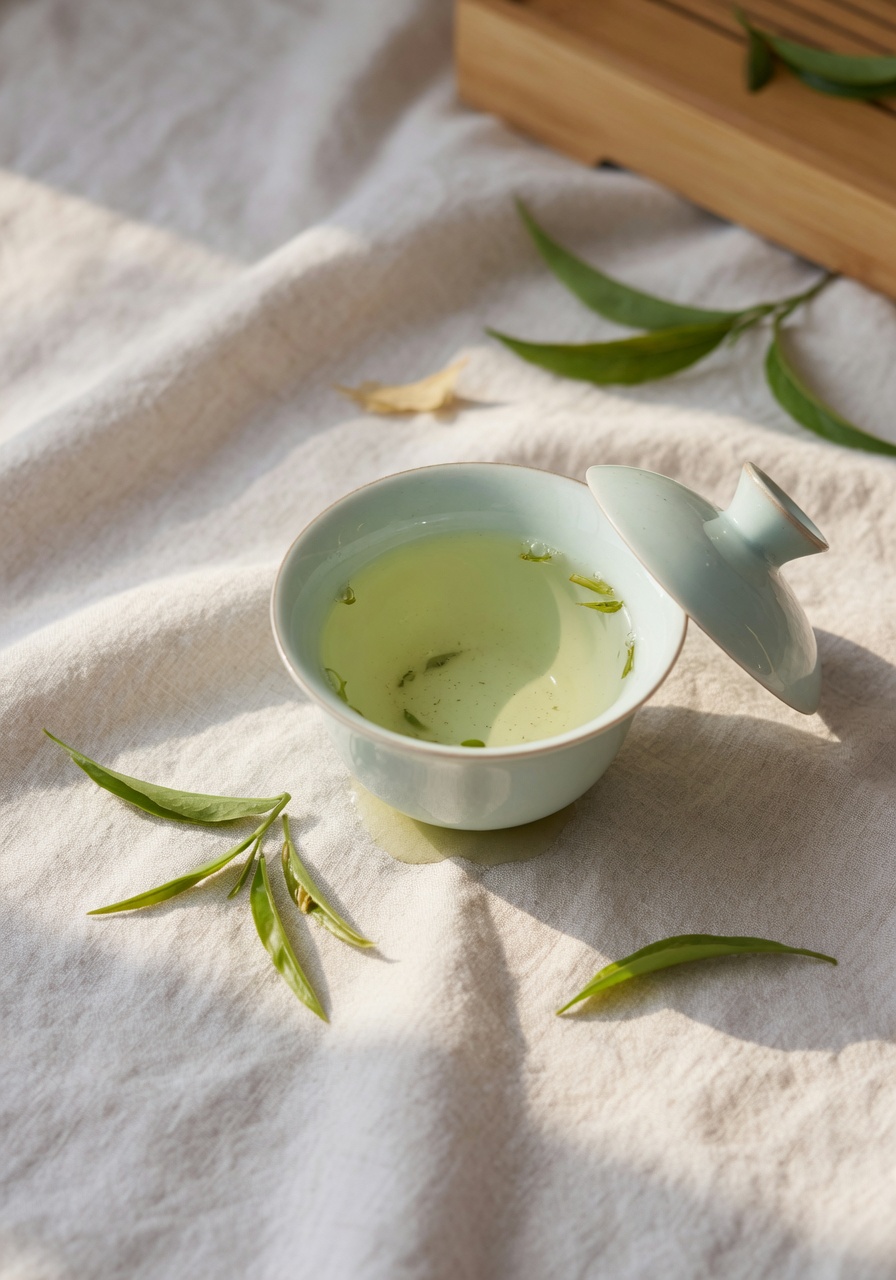
كمية EGCG الفعلية في كوب شاي حقيقي
تستخدم دراسات الكبسولات 300–800 مغ من EGCG. أما كوب شاي أخضر في غايوان واحد فيقدم جزءاً بسيطاً من ذلك — وهذا الفرق أكثر أهمية مما تعترف به معظم كتابات العافية.
كم كوبًا أكثر مما ينبغي — مسألة سلامة الكلى
نظرة متزنة على الاستهلاك اليومي، وأوكسالات، وحمولة الكافيين، ومتى ينبغي لشاربي الشاي الصيني أن يخففوا السرعة — بدون مسرحيات طبية.