home · Сколько чая — <em>слишком много</em> чая
Гидратация, кофеин, здоровье почек
Сколько чашек — уже слишком много: вопрос безопасности для почек
Взвешенный взгляд на суточное потребление, оксалаты, кофеиновую нагрузку и моменты, когда любителям китайского чая стоит сбавить темп — без театральной медицинской драматизации.
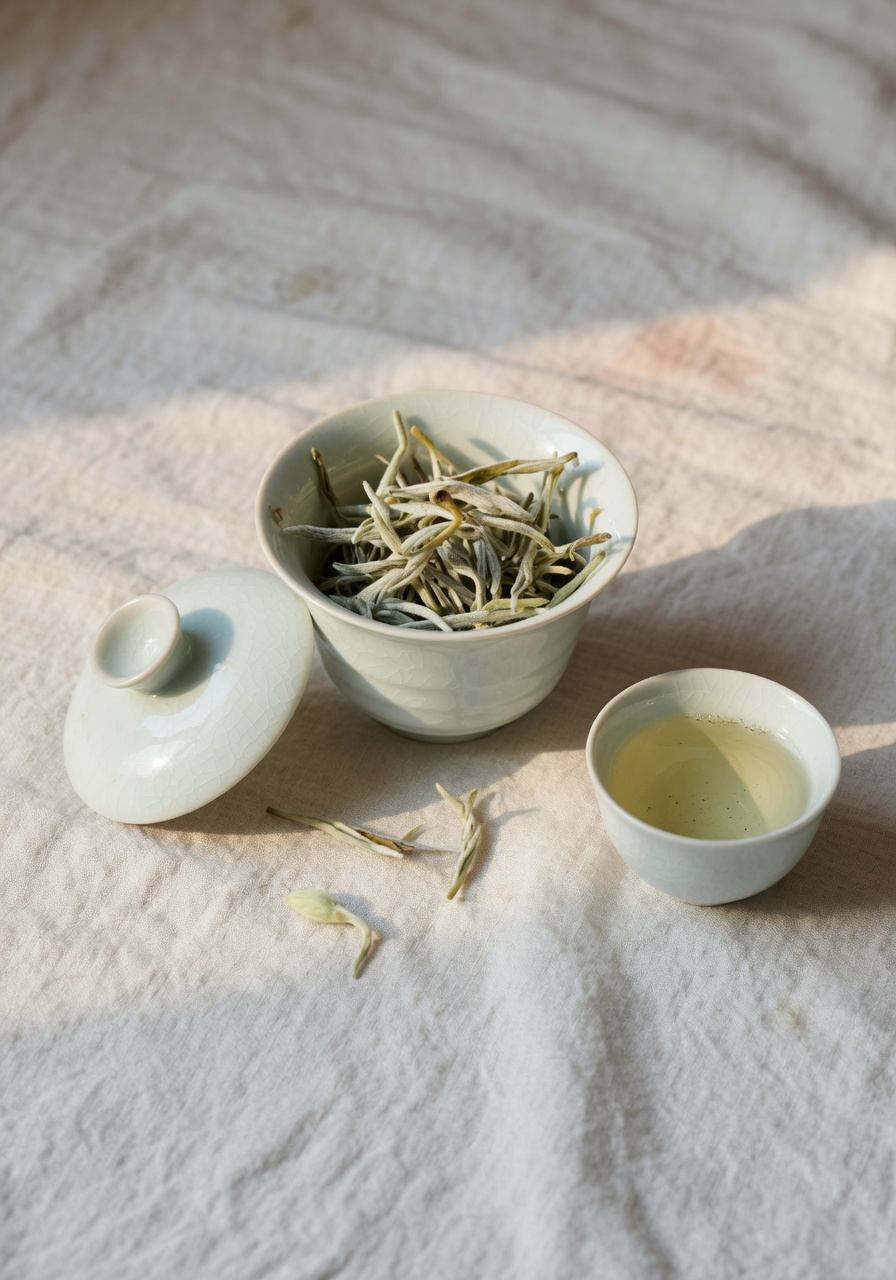
The question arrives at the shop counter more often than any other. A customer in Guangzhou last March held up a 357 g cake of 2018 Shòu Méi (寿眉) and asked, plainly, whether eight cups a day would damage her kidneys. She had read three contradictory articles that morning. Her doctor had said «умеренность». Her mother-in-law had said «никогда на голодный желудок». A wellness blog had warned of oxalate stones. The answer she wanted was a number. The honest answer is that the number depends on which tea, what strength, what her baseline fluid intake looks like, and whether she has any underlying kidney condition to begin with. None of this is medical advice — this article is an editorial review of the published literature and the traditional cautions that have travelled alongside Chinese tea for at least four centuries. For anything resembling a personal diagnosis, the conversation belongs with a nephrologist, not a tea writer. What I can offer is the shape of the evidence as it stands in late 2024, the specific compounds that matter, and the volumes at which careful researchers have flagged concern. The short version, which I will earn over the next twelve hundred words: for a healthy adult, three to six cups of properly brewed Chinese tea per day sits well inside the safety envelope described in the literature. Above eight, the picture grows noisier. Above fifteen, case reports begin to accumulate.
Что на самом деле означает «чашка»
Before any threshold conversation can be useful, we have to agree on the unit. The Western nutrition literature usually defines a cup as 240 ml of brewed liquor made from roughly 2 g of leaf — a teabag-style ratio. Chinese gōngfū brewing inverts this. A standard 110 ml gàiwǎn (盖碗) holds 5 to 7 g of leaf for a Tiě Guān Yīn (铁观音) or a young shēng pǔ’ěr (生普洱) and is steeped eight to fifteen times in short infusions. By volume of liquor, one gōngfū session can easily produce 800 ml — what the USDA would call three to four cups. The actual caffeine and polyphenol load, however, depends not on volume but on leaf weight, water temperature, and total steep time. A 6 g session of Bái Háo Yín Zhēn (白毫银针) brewed at 85 °C for short infusions delivers a markedly different chemical profile than the same 6 g pushed at 95 °C for two minutes per steep. The studies that report «cups per day» rarely specify which convention they used, which is the first reason the public-facing numbers feel contradictory. When in doubt, count leaf grams: 10 to 18 g of dry leaf per day is the working envelope most of the cohort studies appear to describe.
Кофеиновый баланс
Caffeine is the most-studied molecule in tea and the one the kidneys process most visibly. The European Food Safety Authority’s 2015 opinion places 400 mg per day as the threshold above which acute risk markers begin to climb in healthy adults, with 200 mg per single dose flagged as a reasonable ceiling. Chinese teas vary enormously. A 6 g infusion of Lóngjǐng (龙井) from Méijiāwù tends to land between 30 and 50 mg of caffeine across the first three steeps; a comparable weight of young shēng from a Bùlǎng-shān (布朗山) producer can push 80 to 110 mg in the same window. Bái Háo Yín Zhēn sits surprisingly high — silvery buds are caffeine-rich despite the gentle taste — while well-aged shú pǔ’ěr (熟普洱) is generally lower because part of the caffeine has bound to oxidised polyphenols during wò duī (渥堆) pile fermentation.
Как в этом участвуют почки
Caffeine itself is not nephrotoxic at culinary doses. It is a mild diuretic, which is why the 1990s panic about tea «dehydrating» you was overstated — the net fluid balance of a brewed cup is positive. The clinical concern arises in two specific populations: people with chronic kidney disease stage 3 or higher, where caffeine clearance slows and accumulates, and people taking medications that share the CYP1A2 pathway. For the rest of the population, caffeine clears the kidneys briskly. The 2017 review by Wikoff and colleagues in Food and Chemical Toxicology found no consistent renal signal up to 400 mg/day in healthy adults — a figure that comfortably accommodates four to six cups of most Chinese teas.
Оксалаты и вопрос камнеобразования
The more legitimate concern, and the one nephrologists actually raise in clinic, is oxalate. Tea is one of the higher dietary sources of soluble oxalate, and calcium oxalate stones account for roughly 75 % of kidney stones diagnosed globally. A 2017 paper from the Beth Israel Deaconess group looked at three large American cohorts and found that consumption above six cups per day was associated with a modest increase in stone risk among men with prior stone history — but not in women, and not in stone-naïve men. Chinese tea oxalate levels vary by category. Green teas tested at the Институте чайных исследований Hángzhōu in 2018 showed 4.5 to 7.2 mg of soluble oxalate per gram of dry leaf; black teas (hóng chá) ran higher, 5.8 to 9.1 mg/g; lightly oxidised oolongs sat in between. Bái chá (白茶) tested at the lower end of green tea range. For an adult with no stone history and reasonable calcium intake at meals — calcium binds oxalate in the gut and prevents most of it reaching the kidneys — six cups of green tea contribute perhaps 60 to 90 mg of oxalate, which is less than a single serving of cooked spinach.
Практические меры предосторожности для склонных к камнеобразованию
If you have a documented history of calcium oxalate stones, three things move the risk needle more than total cup count. First, drink tea with food so that dietary calcium can intercept oxalate in the small intestine. Second, favour shorter infusions — oxalate continues to leach into the liquor across the first two minutes, so a gōngfū session of fifteen-second steeps extracts noticeably less than a single five-minute Western brew of the same leaf. Third, maintain total daily fluid above 2.5 litres regardless of how much of it is tea. The point is dilution of urinary oxalate, not abstinence from tea.
Фактор выдержанного чая
Older shēng pǔ’ěr and traditional liù bǎo (六堡) introduce a separate question: fluoride. The mature leaves and stems used in shú and aged shēng concentrate fluoride at higher levels than spring-flush green teas. A 2013 survey published in Food Chemistry by Cao and colleagues found that brick teas from Hunan and Sichuan, traditionally consumed in butter-tea form across Tibetan and Mongolian communities, could deliver 4 to 9 mg of fluoride per litre of liquor — enough that the WHO has documented skeletal fluorosis in heavy consumers drinking one to two litres daily across decades. For the typical pǔ’ěr drinker in a coastal Chinese city brewing 8 g of cake-pressed material once a day, the exposure is a fraction of that. But it is the one realistic concern for someone consuming aged dark teas at high volumes for years. The encyclopaedia entry on aged sheng over at puerh.app discusses the storage chemistry in more detail.
Что показывают когортные исследования
The largest dataset on tea and kidney outcomes comes from the China Kadoorie Biobank, which followed roughly 500 000 adults across ten provinces from 2004 onward. Analyses published through 2020 found no association between regular tea drinking and incident chronic kidney disease, and a modest inverse association between green tea consumption and progression of pre-existing CKD in subgroups — though the authors were careful to flag confounding with lifestyle factors. A separate Japanese cohort study published in Nephrology Dialysis Transplantation in 2019 reached a similar conclusion for green tea up to five cups daily. None of these studies vindicates unlimited intake. What they do suggest is that the kidney-damage narrative, repeated in wellness media, has very thin epidemiological support at typical consumption volumes. The risk signals, when they appear, are concentrated in three groups: existing stone-formers, people with established CKD, and very heavy consumers of brick or aged dark tea over decades.
Практический ответ
For a healthy adult with no history of kidney stones or kidney disease, drinking four to six cups of properly brewed Chinese tea per day — roughly 10 to 15 g of dry leaf — falls comfortably within the safety envelope described by the current literature. Pushing to eight cups is not dangerous in itself, but the caffeine load starts to interact with sleep quality and, in some people, blood pressure. Above twelve cups daily for years, the conversation deserves a check-in with a doctor, particularly if the tea is heavily aged or brick-pressed. The customer in Guangzhou with her cake of Shòu Méi eventually settled on a six-steep morning session and a lighter afternoon gōngfū round — perhaps 12 g of leaf across the day. She brews with food, she drinks water alongside, and her last cup is before 4 pm. None of this is prescription. It is the rhythm of a tea drinker who has read the evidence and decided to stop counting cups. The tea-and-health series at tea.school covers the brewing-temperature side of the same question in finer detail.
Когда стоит отставить чашку
Three signals matter more than any cup-count threshold. Sleep disruption beyond 11 pm despite an afternoon cut-off suggests slow caffeine clearance and warrants reducing total leaf weight by a third. Persistent flank pain, blood in urine, or a family history of stones means the conversation needs a nephrologist before the next purchase. And any prescription medication that mentions tea, caffeine, or CYP1A2 in its interaction list — warfarin, certain antipsychotics, some chemotherapy agents — overrides everything in this article. Tea is a 1500-year-old beverage with a remarkably benign safety profile at customary volumes. It is also, like every concentrated plant infusion, a real pharmacological agent. The right number of cups is the one you can defend after reading the literature and listening to your body — not the one a blog post hands you.
References
- Научное заключение о безопасности кофеина — EFSA Panel on Dietetic Products, Nutrition and Allergies, 2015
- Безопасность потребляемого кофеина: всесторонний обзор — Wikoff D. et al., Food and Chemical Toxicology, 2017
- Кофеинсодержащие и бескофеиновые напитки и риск образования камней в почках — Ferraro PM. et al., American Journal of Clinical Nutrition / Beth Israel Deaconess, 2014–2017
- Содержание фтора в китайских прессованных чаях и оценка риска для здоровья — Cao J. et al., Food Chemistry, 2013
- Потребление чая и хроническая болезнь почек в Китайском биобанке Kadoorie — China Kadoorie Biobank collaborative analyses, 2018–2020
- GB/T 30357.1-2013 — Стандарт классификации улунского чая — Standardization Administration of the People's Republic of China
Read next
Related articles
Соотношение теанина к кофеину — что показали исследования
L-теанин достигает мозга. Кофеин его пробуждает. Интересен не вопрос, работают ли они по отдельности, а то, какое действие оказывает их соотношение — и какие дизайны исследований были проверены на практике.
Чай во время беременности — что говорит акушерско-гинекологическая литература
Кофеин, полифенолы, взаимодействие с фолатами и вопрос о том, какие китайские чаи достаточно мягки для беременной. Взвешенный взгляд на то, что на самом деле сообщают акушерские исследования.
Выдержанный шэн и липиды сыворотки — взвешенный взгляд на статью 2019 года
Команда Куньминского медицинского университета сообщила, что теабраунины, извлечённые из пуэра, снижали холестерин у мышей. Статья разошлась далеко — иногда слишком далеко. Здесь — что она измерила, чего не измерила и как выдержанный шэн вписывается в картину.