home · author
The team
Chen Hui Yi
Senior Tea Expert (White, Green & Yellow Tea Varieties)
Guangdong
Chen Hui Yi grew up in Chaozhou, Guangdong, but her professional life is mapped onto the white-tea hills of northern Fujian — Fuding, Zhenghe, and the higher gardens above Panxi. She crossed the provincial border for the first time at nineteen, in the spring of 2006, to apprentice under Lin Zhenchuan, a third-generation withering master in Diantou Town whose family had supplied buds to the Fuding state factory since the 1970s. Under Lin she learned to read the weather the way pickers do: by the angle of the sun on the bamboo trays, by the way Bái Háo Yín Zhēn (白毫银针) buds curl when humidity passes 78 percent, by the silence of a good withering shed at four in the morning.
Her technical grounding came later, at the Fujian Agriculture and Forestry University extension program in Fu'an (2010–2012), where she trained against GB/T 22291-2017 (the national standard for white tea) and GB/T 31751 for compressed whites. She still keeps the worn copy of the standard in her field bag, annotated in red ink alongside Lin's hand-drawn drying curves. Between 2013 and 2019 she worked as a quality auditor for a small cooperative of twelve growers around Mount Taimu, where the gardens sit between 600 and 850 metres and the Dà Bái (大白) cultivar accounts for roughly 70 percent of plantings.
Her focus on aged whites began almost by accident. In 2015, helping Lin clear a back room, she opened a 2008 Shòu Méi (寿眉) cake that had been forgotten behind sacks of fresh material. The liquor was the colour of dark amber and tasted of dried longan and old wood. She has spent the decade since cataloguing how Bái Mǔ Dān (白牡丹) and Shòu Méi change between years three, seven, and fifteen, working with the Fuding Tea Research Institute on flavonoid retention data. Her notes on moonlight white from the Jinggu area of Yunnan — a variety she treats as a cousin rather than a true white — are referenced in puerh.app's white-tea cross-listings.
On tea.doctor, Chen reads research the same way she reads a withering shed: slowly, and with an eye for what is being left out. Her article "How much EGCG is actually in a real brew" came from her frustration that lab extraction studies almost never match a 3 g / 150 ml gongfu pour, and that readers were being told to chase polyphenol numbers that exist only in methanol solvents. In "The theanine-to-caffeine ratio — what the studies measured," she walks through why silver-needle buds — picked in a ten-day window in late March — carry a different L-theanine load than later-flush Shòu Méi, and why ratio claims need to specify pluck grade. Her piece on pregnancy and tea is the one she rewrote most often; she defers to the OB-GYN literature and refuses to translate tradition into prescription.
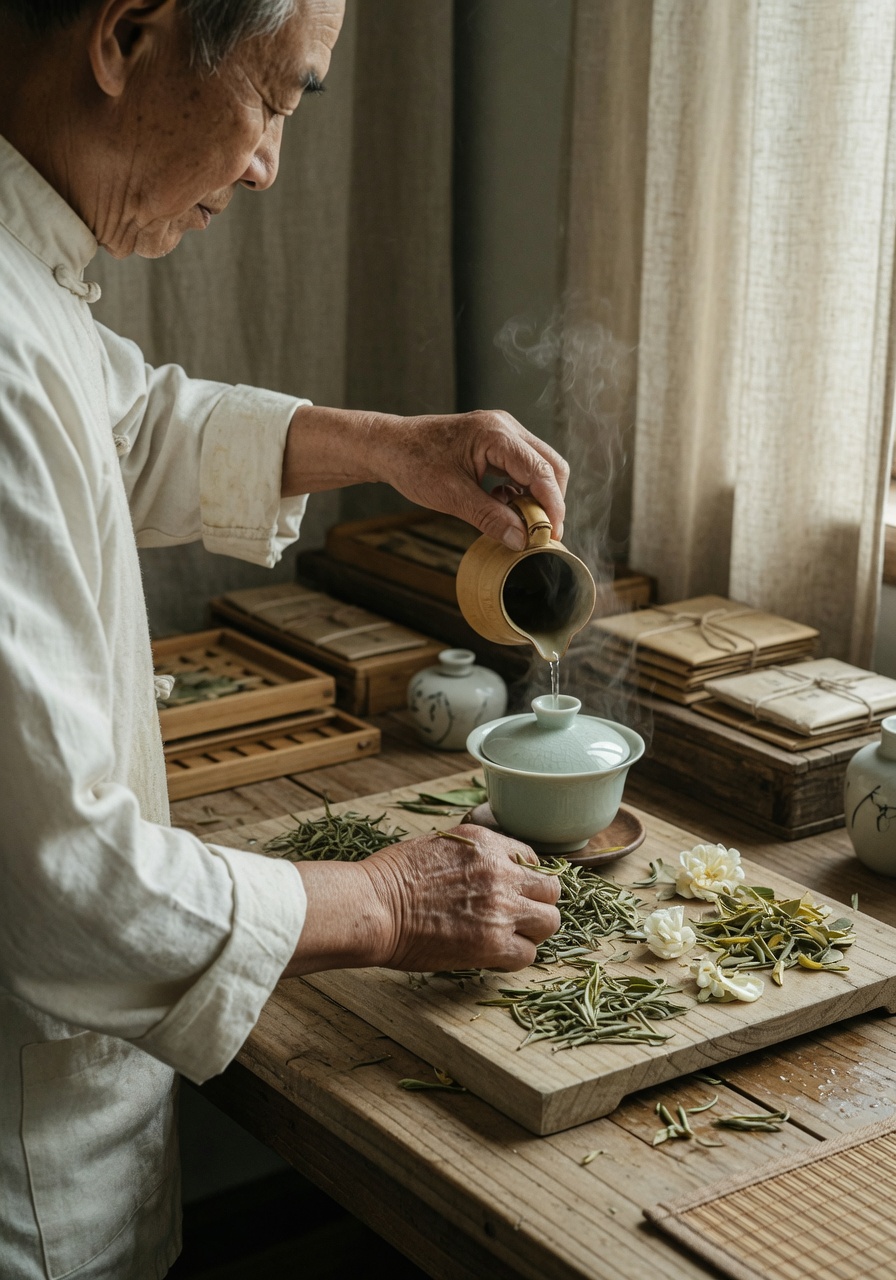
Chen teaches the white-tea path on tea.school each spring and autumn, and acts as the senior vendor expert for white, green, and yellow varieties on shop.thetea.app. She lives between Shantou and Fuding, drinks two grams of 2017 Bái Mǔ Dān every morning in a thin-walled porcelain gàiwǎn (盖碗), and keeps a personal archive of 142 dated white-tea pressings going back to 2008.
Specialties
- white tea
- green tea
- yellow tea
- yinzhen
- shou mei
- bai mu dan
- moonlight white
- aged whites